A compound subject brings together two or more people, places, or things that share the same action in a sentence. Instead of having only one subject connected to the verb, a compound subject lets multiple subjects work as a single unit. You see this structure everywhere, stories, instructions, conversations, and academic writing, because it makes ideas clearer and more complete.
Understanding how compound subjects work helps you avoid common mistakes with subject–verb agreement and gives you more control over your sentence structure. Whether the subjects are joined with “and,” “or,” “nor,” or appear as a combined idea, the pattern stays surprisingly simple once you learn to spot it. The goal is to recognize the subject first, understand how it connects to the verb, and build sentences that express your meaning without confusion.
What Is a Compound Subject?
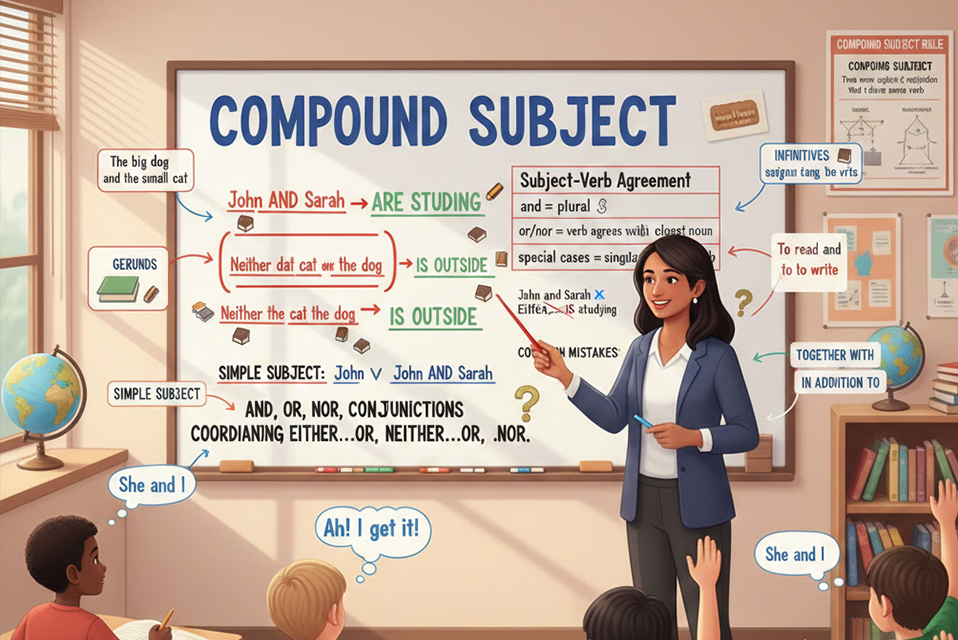
A compound subject is simply a subject made up of two or more nouns, pronouns, or noun phrases that share the same verb. When the subjects are joined with conjunctions like and, or, nor, or paired structures such as either or neither…nor, they form a compound subject.
Example:
                  "John and Sarah are studying for the exam."
 Here, John and Sarah operate together as the subject of are studying.
A compound subject still performs the same function as any subject, it tells who or what the sentence is about, but it allows the sentence to refer to multiple things at once.
Why Compound Subjects Matter
Many errors in writing happen at the subject level, especially when more than one subject is present. A strong understanding of compound subjects improves clarity, strengthens sentence structure, and leads to mastery of subject–verb agreement.
Simple Subject vs. Compound Subject
Before diving deeper, it helps to contrast the simple subject with the compound subject.
Simple Subject
A simple subject contains only one noun or pronoun. Example: The dog barks.
Compound Subject
A compound subject has at least two parts. Example: The dog and the cat bark.
Quick Comparison Table
| Structure | Example | How It Works |
| Simple Subject | The teacher explains. | One noun performing the action |
| Compound Subject with “and” | The teacher and the students discuss. | Two or more nouns act together |
| Compound Subject with “or” | The teacher or the assistant explains. | Verb agrees with the closer noun |
| Compound Subject with pronouns | She and I are ready. | Pronouns combine to form the subject |
This simple distinction is the foundation for the rules that follow.
How to Form a Compound Subject
You can form a compound subject in several ways, and understanding these helps you identify them easily.
Using Coordinating Conjunctions
The most common way is joining nouns or pronouns using and, or, or nor.
- Tom and Jerry run quickly.
- The keys or the wallet is on the table.
- Neither the manager nor the employees were aware.
Using Correlative Conjunctions
Correlative conjunctions work in pairs:
- either…or
- neither…nor
- both…and
- not only…but also
Examples:
- Either the teacher or the students are preparing the presentation.
- Both confidence and clarity matter in writing.
Using Pronouns
Compound subjects often contain pronouns:
- She and they arrived early.
- You and I need to talk.
Read Also : What are Interrogative Pronoun?
Using Gerunds and Infinitives
Gerunds (verb + ing) and infinitives (to + verb) can function as compound subjects too.
- Running and swimming improve stamina.
- To read and to write are essential skills.
Read Also: What Are Split Infinitives?
Using Noun Phrases
Sometimes the parts are full noun phrases:
- The boy in the red shirt and the girl with the ponytail were laughing.
Compound subjects can appear in simple, compound, complex, or compound–complex sentences. Regardless of sentence type, the structure behaves the same: multiple elements acting as one subject.
Subject–Verb Agreement With Compound Subjects
This is the area where most students need guidance. The verb must match the subject, and with compound subjects, the rules change depending on the conjunction used and the meaning of the sentence.
Let’s go through the full set of rules clearly and simply.
Rule 1 – Compound Subjects Joined by “And” Usually Take a Plural Verb
When subjects are joined by and, they typically act as a plural subject.
- The teacher and the principal are discussing the schedule.
- My brother and my cousin live abroad.
Rule 2 – Subjects Joined by “Or” or “Nor” Agree With the Closest Subject
This is called the proximity rule or closest-subject rule.
- The cat or the dogs are outside.
(The noun closest to are is dogs → plural verb) - The dogs or the cat is hungry.
(The noun closest to is is cat → singular verb) - Neither the boys nor the girl knows the answer.
This rule often confuses learners, so examples and practice help a lot.
Rule 3 – When Two Nouns Represent One Idea, Use a Singular Verb
Sometimes two nouns joined by and express a single idea:
- Peanut butter and jelly is my favorite lunch.
- Macaroni and cheese is delicious.
In these cases, the compound subject behaves like a singular unit.
Rule 4 – Mixed Singular and Plural Subjects
When one part is singular and one is plural, and the conjunction is and, the verb is always plural.
- The teacher and the students are ready.
But if the conjunction is or or nor, use the proximity rule.
Rule 5 – Compound Subjects With Pronouns Follow the Same Agreement Rules
- He and I are friends.
- Either you or she is responsible.
Subject–Verb Agreement Summary Table
| Subject Structure | Correct Verb Form | Example |
| A and B | Plural | Mark and Lisa are coming. |
| A or B | Closest noun | The pencil or the pens are missing. |
| Neither A nor B | Closest noun | Neither the teacher nor the students were prepared. |
| A and B (one idea) | Singular | Bread and butter is all we need. |
| Pronoun combo | Based on rule 1 or 2 | She and they are working. |
Special Cases, Exceptions & Tricky Constructions
Some structures look like compound subjects but behave differently. These often cause mistakes in writing.
1. “As Well As,” “Along With,” “Together With,” “In Addition To”
These expressions do not create compound subjects.
They act as modifying phrases, not as part of the true subject.
- The teacher, along with her students, is attending the workshop.
- My friend, as well as my cousins, is visiting.
Here, teacher and friend remain the true subjects.
2. Compound Subjects With Modifiers
Adjectives, determiners, and phrases may come between parts of the subject.
- The tall boy and the quiet girl walk to school.
- My old notebook and my new laptop are on the desk.
3. Possessives in Compound Subjects
Possessive constructions also appear in compound subjects:
- John’s book and Mary’s notes were misplaced.
- The dog’s barking and the baby’s crying were overwhelming.
4. Compound Subjects in Passive Voice
Even in passive constructions, the subject rules are the same:
- The reports and the letters were mailed yesterday.
- Either the contract or the agreements were signed.
5. Collective Nouns in Compound Structures
Collective nouns can create special meaning:
- The team and the coach are celebrating.
(both are individuals) - The team and coach is ready.
(one unit, depending on meaning)
Teaching students to look for meaning, not just grammar, helps them master these cases.
Common Errors With Compound Subjects
Students frequently fall into predictable traps. Let’s look at the most important ones and how to correct them.
Error 1 – Treating “As Well As” Like “And”
Wrong: The girl as well as her brothers are here.
Correct: The girl, as well as her brothers, is here.
Error 2 – Singular Verb With Plural Compound Subject
Wrong: The dog and the cats is hungry.
Correct: The dog and the cats are hungry.
Error 3 – Not Following the Proximity Rule
Wrong: Neither the boys nor the girl know the answer.
Correct: Neither the boys nor the girl knows the answer.
Error 4 – Confusing Lists With Compound Subjects
A list of items is not always the subject.
Wrong: Running, swimming, and cycling is fun.
Correct: Running, swimming, and cycling are fun.
(Here, the list actually forms a plural compound subject.)
Teaching students to identify the real subject prevents these mistakes.
Compound Subjects in Different Sentence Types
Compound subjects occur in every kind of sentence structure. Showing them in different contexts helps learners see how flexible they are.
Simple Sentences
A simple sentence can still have a compound subject:
- Tom and Jerry chase the mouse.
- Milk and bread are on the table.
Compound Sentences
A compound sentence contains two independent clauses. Each clause may or may not have a compound subject.
- John and Paul play guitar, and Amy sings.
- Either the teacher or the assistant arrived, but neither stayed long.
Complex Sentences
A compound subject may appear in the main clause or the subordinate clause.
- When the rain and wind stop, we can continue.
- I know that the dog and the cat are inside.
Compound–Complex Sentences
These allow for even more variation.
- Although the lights and music were loud, the crowd enjoyed the event, and the performers continued with enthusiasm.
Working through examples in each sentence type strengthens understanding of larger grammatical structures.
Varied Examples of Compound Subjects
One of the best ways to learn grammar is by seeing how it works in real sentences. Below are examples from different contexts.
Everyday Life
- My sister and I are going shopping.
- Coffee or tea is available.
Academic Writing
- Reading and analyzing primary sources help deepen understanding.
- Neither the hypothesis nor the data supports the claim.
Creative Writing
- The moon and stars illuminated the quiet forest.
- Either the hero or his companion will face the challenge.
Professional Communication
- The report and the presentation are due tomorrow.
- Either the manager or the assistants handle customer complaints.
Pronoun-Based Examples
- She and they are planning the project.
- Either he or I am responsible.
Gerund Examples
- Singing and dancing lift the mood.
- Cooking and cleaning are tiring tasks.
These examples help learners recognize patterns across contexts.
Compound Subject vs. Compound Predicate vs. Compound Object
Students often confuse these, so a teacher’s explanation helps clear things up.
Compound Subject
Two or more nouns share the same verb. Example: Tom and Jack run.
Compound Predicate
One subject performs two or more actions. Example: Tom runs and jumps.
Compound Object
Two objects receive the same action. Example: Tom likes apples and oranges.
Comparison Table
| Grammar Element | Question It Answers | Example |
| Compound Subject | Who/what performs the action? | Lilly and James laugh. |
| Compound Predicate | What is the subject doing? | Lilly laughs and dances. |
| Compound Object | What receives the action? | Lilly likes music and poetry. |
Understanding the difference helps students construct clearer, more expressive sentences.
Compound Subject Cheat Sheet (Quick Reference)
- A and B : Plural verb
- A or B / A nor B : Verb agrees with closest noun
- Two nouns = one idea : Singular verb
- Modifiers do not change the subject
- Phrases like “as well as,” “together with,” “in addition to” do not create compound subjects
Read More: What are News Phrase?
Conclusion
A compound subject may seem like a small detail in grammar, but it plays a significant role in the clarity and accuracy of writing. Once you understand how nouns, pronouns, noun phrases, gerunds, and infinitives combine to form subjects, and how conjunctions change the relationship between these elements, you gain a deeper control over sentence structure.
The most important skill is recognizing how the verb should agree with the subject. Whether subjects are joined by and, or, nor, or correlative pairs like either…or, the key is to look closely at meaning and structure. With practice, these rules become second nature.
Mastering compound subjects helps students write with confidence, avoid common errors, and develop strong grammatical instincts. With the guidance and examples in this article, you now have a complete understanding of how compound subjects function in every type of sentence.
Frequently Asked Questions(FAQs)
Can a compound subject take a singular verb?
Yes, when the two nouns express one idea. e.g: Bread and butter is delicious
Do gerunds and infinitives follow the same rules?
Do gerunds and infinitives follow the same rules?
Is “My friend and I is” correct?
No, My friend and I are” is correct.
Do compound subjects always need a comma?
No. Commas are not used within compound subjects unless there is a nonessential phrase.
Can a compound subject be used with passive voice?
Yes, The letters and the invitations were delivered.