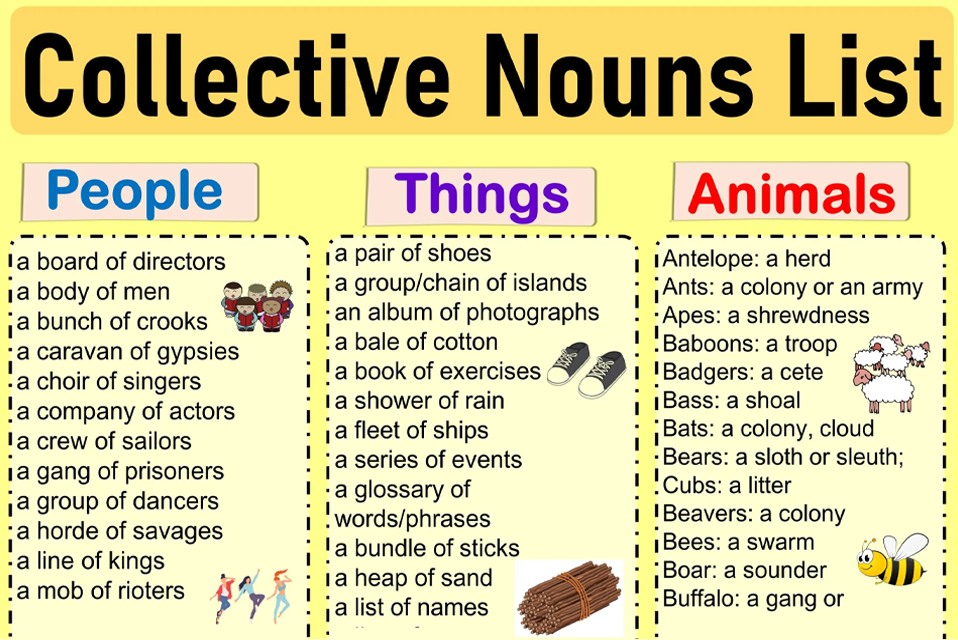
Language has a unique way of grouping the world around us. Instead of listing every individual person, animal, or object separately, English often uses collective nouns to describe a group as a single unit. Words like team, flock, herd, and family instantly create a clear mental image and make communication more efficient and expressive.
Collective nouns are an essential part of everyday English. They appear in spoken language, academic writing, literature, journalism, and even poetry. Understanding how collective nouns work helps learners improve grammar accuracy, sentence flow, and overall clarity. This guide explains collective nouns in depth, with definitions, rules, examples, and categorized lists to help learners of all levels.
What Is a Collective Noun?
A collective noun is a word that refers to a group of people, animals, or things as a single unit. Although the group is made up of many individuals, the collective noun treats them as one entity.
Examples:
- A class of students
- A team of players
- A flock of birds
- A bundle of sticks
In each case, the noun represents multiple members acting or existing together.
Why Collective Nouns Matter in English
Collective nouns play an important role in communication for several reasons:
- Clarity : They simplify complex ideas by grouping individuals.
- Efficiency : One word replaces a long descriptive phrase.
- Style : They add variety and richness to writing.
- Precision : Many collective nouns are specific to certain animals or objects.
For example, saying a pride of lions is more vivid and accurate than saying many lions together.
Collective Nouns vs Plural Nouns
It is important not to confuse collective nouns with plural nouns.
- Plural noun: Refers to more than one individual directly (cats, books, people).
- Collective noun: Refers to a group as a single unit (team, herd, audience).
Example:
- The players are warming up. (plural noun)
- The team is warming up. (collective noun)
Singular and Plural Verb Agreement
One of the most common challenges with collective nouns is verb agreement.
Singular Usage
When the group acts as a single unit, a collective noun usually takes a singular verb.
- The committee decides on the budget.
- The family travels together every summer.
Plural Usage
When the individuals in the group act separately, a plural verb may be used (more common in British English).
- The committee are arguing among themselves.
- The team are wearing different jerseys.
Both forms can be correct depending on meaning and regional style.
Collective Nouns for People
Collective nouns for people describe groups based on roles, activities, or relationships.
Common Collective Nouns for People
- A team of players
- A crowd of people
- A class of students
- A family of relatives
- A committee of members
- A jury of citizens
- A staff of employees
- A choir of singers
- A panel of experts
- A crew of workers
Example Sentences
- The audience applauds loudly at the end of the show.
- The committee meets every Monday.
- The choir sings beautifully during the ceremony.
Collective Nouns for Animals
Animal collective nouns are some of the most interesting and creative in English. Many come from historical usage and literary traditions.
Common Collective Nouns for Animals
- A herd of cattle
- A flock of birds
- A pack of wolves
- A school of fish
- A pride of lions
- A colony of ants
- A swarm of bees
- A litter of puppies
- A gaggle of geese
- A troop of monkeys
Example Sentences
- A flock of birds flies across the sky.
- The pride of lions rests under the tree.
- A school of fish moves in perfect harmony.
Small animals also have specific collective terms, and the most commonly used rats collective noun is widely seen in both literature and everyday language.
Unusual and Rare Animal Collective Nouns
Some collective nouns are less common but add color to language.
- A murder of crows
- A parliament of owls
- A crash of rhinoceroses
- A tower of giraffes
- A bloat of hippopotamuses
- A leap of leopards
- A knot of frogs
These terms are often used in literature and descriptive writing.
Collective Nouns for Things and Objects
Collective nouns are not limited to living beings. Many describe groups of objects.
Common Collective Nouns for Things
- A pile of clothes
- A stack of books
- A bundle of sticks
- A set of tools
- A pair of shoes
- A collection of stamps
- A fleet of ships
- A string of lights
Example Sentences
- A stack of books sits on the desk.
- The fleet of ships leaves the harbor.
- She bought a set of kitchen knives.
In the same way, materials like sand also have specific grouping terms, which are explained in detail in this guide on the collective noun for sand.
Collective Nouns for Professions and Groups
Some collective nouns are associated with specific professions or organized groups.
- A regiment of soldiers
- A band of musicians
- A cast of actors
- A board of directors
- A faculty of teachers
- A press of reporters
These nouns are commonly used in formal and professional contexts.
Collective Nouns in American vs British English
Usage of collective nouns can differ between American and British English.
- American English tends to treat collective nouns as singular.
- The team is winning.
- British English often treats them as plural when emphasizing individuals.
- The team are winning.
Both forms are grammatically acceptable depending on context and style.
Collective Nouns with Articles and Determiners
Collective nouns are often used with articles and determiners:
- a team
- the family
- this group
- that crowd
Example:
- The jury reaches a decision.
- A group of tourists arrives early.
Collective Nouns and Pronouns
Pronoun agreement follows the same logic as verb agreement.
- The team lost its match. (single unit)
- The team lost their confidence. (individual members)
Choosing the correct pronoun depends on meaning.
Collective Nouns in Formal Writing
In academic and professional writing, collective nouns improve clarity and conciseness.
- The committee recommends changes.
- The organization supports the proposal.
Consistency in verb agreement is especially important in formal contexts.
Collective Nouns in Literature and Creative Writing
Writers often use collective nouns to create imagery and emotion.
- A murder of crows darkened the sky.
- A whisper of leaves filled the forest.
Such usage enhances descriptive power and tone.
Common Mistakes with Collective Nouns
- Incorrect verb agreement
- Incorrect: The team are winning. (American English context)
- Correct: The team is winning.
- Using plural nouns unnecessarily
- Incorrect: A group of students are here. (formal)
- Correct: A group of students is here.
- Overusing rare collective nouns
- Use unusual terms carefully to avoid confusion.
Teaching Collective Nouns to Students
Teachers often introduce collective nouns using visual aids and examples.
Effective strategies include:
- Matching games
- Picture-based learning
- Sentence-building exercises
- Story writing activities
These methods help learners remember usage naturally.
Practice Examples
Identify the collective noun:
- A flock of sheep grazes in the field.
- The jury delivers its verdict.
- A bundle of papers lies on the table.
Summary of Collective Nouns
Collective nouns are words that represent groups as single units. They are used for people, animals, and things and play a vital role in English grammar. Correct usage depends on context, meaning, and sometimes regional style. Mastering collective nouns improves fluency, accuracy, and expressive power in both writing and speech.
Conclusion
Collective nouns make English richer and more precise. Whether describing a team of players, a herd of animals, or a stack of books, these nouns help speakers and writers communicate efficiently. By understanding their rules, variations, and contexts, learners can use collective nouns confidently and correctly in everyday English. With practice and exposure, collective nouns become a natural and powerful part of language use.
Frequently Asked Questions (FAQs)
What is a collective noun?
A collective noun is a word that refers to a group of people, animals, or things as a single unit. Even though the group contains many individuals, it is treated as one entity in a sentence, such as team, herd, or class.
Are collective nouns singular or plural?
Collective nouns can be singular or plural depending on how they are used. When the group acts as one unit, the noun takes a singular verb. When the individuals act separately, it may take a plural verb, especially in British English.
What are some common collective nouns for animals?
Common collective nouns for animals include a flock of birds, a herd of cattle, a pack of wolves, a school of fish, and a pride of lions.
What is the difference between collective nouns and plural nouns?
Plural nouns directly show more than one item, such as books or students. Collective nouns, on the other hand, represent a group as a single unit, such as library or class.
Why are collective nouns important in English?
Collective nouns make communication clearer and more efficient. They help avoid repetition, improve sentence flow, and add descriptive strength to both spoken and written English.