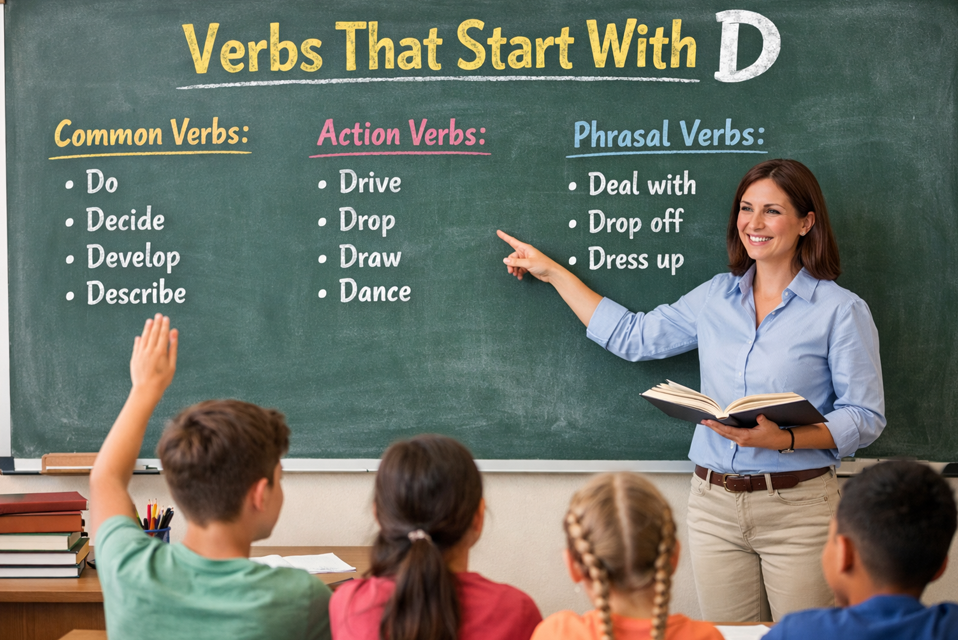
Verbs are the engine of the English language. They express action, state, movement, change, and intention. Without verbs, sentences lose direction and meaning. Among the many letters that begin English verbs, the letter D stands out for its richness and versatility. Verbs that start with D are used to describe thinking, speaking, movement, emotions, decisions, and transformations in both everyday and academic language.
This guide explores verbs that start with D in a structured and practical way. You will find common verbs, advanced verbs, phrasal verbs, action verbs, mental verbs, positive and negative verbs, and verbs used in professional and creative writing. Each section is designed to deepen understanding and improve real-life usage.
Why Verbs That Start With D Matter
Verbs beginning with D are extremely frequent in English. Words like do, decide, develop, and describe appear in daily conversations, textbooks, reports, and stories. These verbs often signal:
- Decision-making
- Change or transformation
- Communication and explanation
- Emotional or mental states
- Physical or abstract actions
Mastering these verbs helps learners express ideas more clearly, write with confidence, and speak more fluently.
Common Verbs That Start With D
These are some of the most frequently used D verbs in spoken and written English. They are essential for beginners and remain important at advanced levels.
- Do : to perform an action
- Decide : to make a choice
- Develop : to grow or improve
- Describe : to explain in words
- Drive : to operate a vehicle or motivate
- Discuss : to talk about a topic
- Draw : to create an image or pull something
- Deliver : to bring or provide
- Dance : to move rhythmically
- Drink : to consume liquid
These verbs form the foundation of everyday communication.
Action Verbs That Start With D
Action verbs describe physical or visible activities. Many D verbs clearly show movement or effort.
- Dig : to break ground
- Drag : to pull with effort
- Drop : to let something fall
- Dive : to jump into water
- Dash : to run quickly
- Defend : to protect
- Destroy : to ruin completely
- Deliver : to transport goods
- Dump : to discard carelessly
Action verbs are especially important in storytelling, instructions, and descriptive writing.
Mental and Thinking Verbs That Start With D
Some verbs beginning with D relate to thought, understanding, and awareness.
- Decide : to choose after thinking
- Doubt : to feel uncertain
- Determine : to conclude firmly
- Dream : to imagine or envision
- Deduce : to reach a conclusion
- Deliberate : to think carefully
- Detect : to notice or discover
- Discern : to recognize differences
These verbs are commonly used in academic writing, psychology, and analytical discussions.
Communication Verbs That Start With D
Many D verbs help express speaking, explaining, or sharing information.
- Describe : to explain in detail
- Discuss : to exchange ideas
- Declare : to announce officially
- Debate : to argue different viewpoints
- Demand : to ask forcefully
- Deny : to say something is not true
- Disclose : to reveal information
- Dictate : to speak for others to write
These verbs are essential in professional, legal, and educational contexts.
Positive Verbs That Start With D
Some verbs that start with D carry positive meanings and are useful for encouragement, growth, and achievement.
- Develop : to grow or improve
- Deliver : to succeed or fulfill
- Dedicate : to commit time or effort
- Delight : to give pleasure
- Discover : to find something new
- Donate : to give willingly
- Dream : to imagine positively
- Drive : to motivate or push forward
Using positive verbs strengthens persuasive and motivational writing.
Negative Verbs That Start With D
Other D verbs express conflict, difficulty, or harm. These are useful for realistic storytelling and critical discussion.
- Damage : to cause harm
- Deceive : to mislead
- Destroy : to ruin completely
- Deny : to refuse or reject
- Delay : to postpone
- Depress : to cause sadness
- Disappoint : to fail expectations
- Dominate : to control unfairly
Understanding these verbs helps convey tension, problems, and challenges accurately.
Academic and Formal Verbs That Start With D
In formal writing and education, certain D verbs appear frequently.
- Demonstrate : to show clearly
- Define : to explain meaning
- Differentiate : to show differences
- Derive : to obtain from a source
- Determine : to establish firmly
- Document : to record information
- Debate : to examine opposing views
- Diagnose : to identify a problem
These verbs are especially important for essays, reports, and research papers.
Phrasal Verbs That Start With D
Phrasal verbs combine a verb with a preposition or adverb. Many D phrasal verbs are common in conversational English.
- Deal with : to handle a situation
- Depend on : to rely on
- Drop off : to fall asleep or deliver
- Dress up : to wear formal clothes
- Do over : to repeat
- Die out : to disappear gradually
- Drag on : to continue too long
- Drive away : to force to leave
These verbs add natural flow to spoken English.
Verbs That Start With D for Writing and Creativity
Writers often choose D verbs for strong imagery and precise expression.
- Depict : to represent vividly
- Describe : to create detail
- Dramatize : to make more exciting
- Develop : to expand ideas
- Deepen : to add emotional intensity
- Distort : to twist reality
- Define : to clarify meaning
These verbs help shape narratives, essays, and poetry.
Business and Professional Verbs That Start With D
In the workplace, many D verbs are commonly used.
- Delegate : to assign tasks
- Deliver : to complete work
- Develop : to build skills or products
- Direct : to guide or manage
- Decide : to choose a course of action
- Document : to record processes
- Deploy : to use resources
- Differentiate : to stand apart
These verbs support clear communication in professional settings.
Transitive and Intransitive Verbs That Start With D
Some D verbs require an object (transitive), while others do not (intransitive).
Transitive examples:
- Deliver a package
- Describe a scene
- Destroy a building
Intransitive examples:
- Dance gracefully
- Disappear suddenly
- Die peacefully
Understanding this difference improves sentence structure and accuracy.
Irregular Verbs That Start With D
A few D verbs have irregular past forms.
- Do → did → done
- Draw → drew → drawn
- Drink → drank → drunk
- Drive → drove → driven
These verbs are essential to master because they are used so often.
Verbs That Start With D for Students and Learners
For learners, building vocabulary with D verbs improves fluency.
Beginner-friendly verbs:
- Do
- Drink
- Dance
- Draw
- Drop
Intermediate verbs:
- Decide
- Develop
- Describe
- Discover
Advanced verbs:
- Deliberate
- Differentiate
- Disclose
- Deduce
Gradual learning helps learners use verbs confidently and correctly.
Using Verbs That Start With D in Sentences
Correct usage depends on context and tense.
- She decided to change her career.
- They developed a new plan.
- He described the event clearly.
- We discussed the issue calmly.
- The team delivered excellent results.
Practice with real sentences strengthens retention.
Common Mistakes With D Verbs
Learners sometimes confuse similar verbs:
- Decide vs. Determine
- Describe vs. Depict
- Delay vs. Deny
- Discover vs. Develop
Understanding subtle differences prevents misuse and improves clarity.
Read Also: Verbs That Start With A
How to Expand Vocabulary Using D Verbs
To master verbs that start with D:
- Learn verbs in context, not isolation
- Practice writing short paragraphs
- Group verbs by meaning
- Use them in speaking exercises
- Review regular verbs & irregular forms regularly
Consistent exposure leads to long-term improvement . Also you can play game like Letter Boxed Unlimited to practice these verb Online in a better way.
Complete List of Useful Verbs That Start With D
Here is a broad selection of commonly used D verbs:
| Verb | Verb | Verb |
| Do | Dance | Decide |
| Develop | Describe | Discover |
| Deliver | Demand | Deny |
| Delay | Destroy | Design |
| Drive | Drink | Draw |
| Debate | Declare | Defend |
| Delegate | Demonstrate | Determine |
| Differentiate | Document | Donate |
| Dream | Drop | Diagnose |
| Depict | Discern | Deduce |
| Deliberate | Deploy | Dominate |
| Disturb | Disappear | Deepen |
| Direct | Define | Dazzle |
Final Thoughts
Verbs that start with D play a powerful role in English communication. They express action, thought, emotion, decision, and change. From simple daily actions like do and drink to advanced concepts like differentiate and demonstrate, these verbs support clear and effective expression.
By understanding meanings, usage, and context, learners and writers can confidently use D verbs to strengthen speech and writing. Regular practice and thoughtful application will turn these verbs into natural tools for communication.
Frequently Asked Questions
What are verbs that start with D?
Verbs that start with D are action or state words beginning with the letter D that describe what someone does, thinks, feels, or experiences. Common examples include do, decide, develop, describe, and deliver.
Why are verbs that start with D important in English?
These verbs are widely used in everyday conversation, academic writing, and professional communication. They help express decisions, actions, explanations, emotions, and changes, making sentences clearer and more meaningful.
Are there irregular verbs that start with D?
Yes, some verbs that start with D are irregular, meaning their past forms do not follow standard rules. Examples include do (did, done), draw (drew, drawn), drink (drank, drunk), and drive (drove, driven).
How can students learn verbs that start with D more easily?
Students can learn these verbs by using them in sentences, grouping them by meaning, practicing speaking and writing, and reviewing examples regularly. Learning verbs in context helps improve long-term understanding.
Can verbs that start with D be used in both formal and informal writing?
Yes. Many D verbs work in casual conversation (like do, dance, drop) as well as formal and academic writing (such as demonstrate, determine, differentiate, and document). The key is choosing the right verb for the situation.