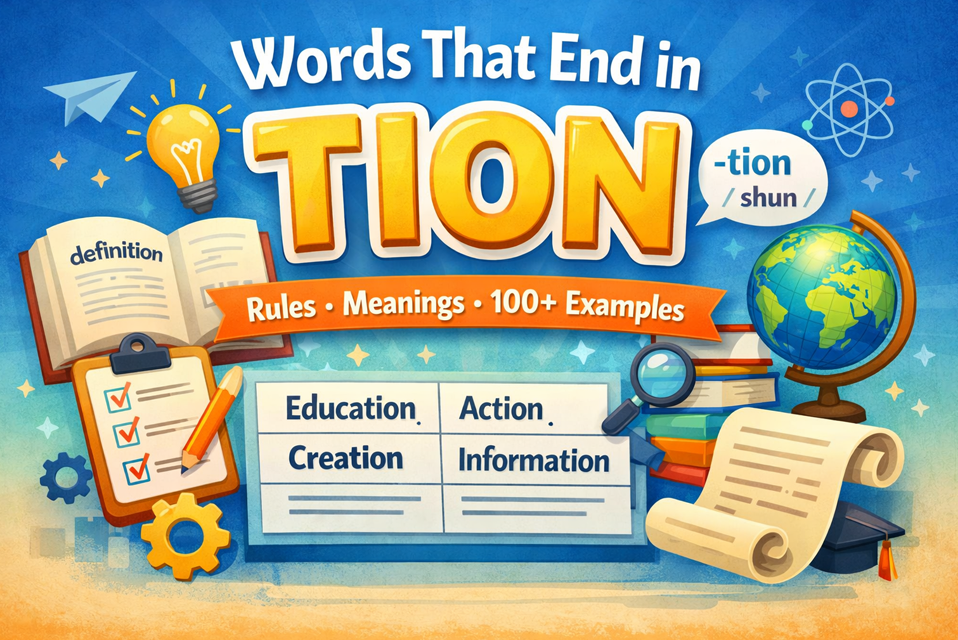
English spelling is full of patterns that quietly shape how we read, write, and understand words. One of the most common and powerful patterns is the suffix “-tion.” You see it everywhere: education, information, communication, solution, and hundreds more. These words appear frequently in academic writing, professional communication, exams, and everyday reading.
Words that end in -tion usually represent nouns and often describe actions, processes, results, or states of being. Understanding how these words work helps learners expand vocabulary, improve spelling accuracy, and write more confidently. This article explores the meaning, origin, spelling rules, pronunciation patterns, and practical usage of words ending in -tion, followed by a comprehensive table of more than 100 examples.
What Does the Suffix “-Tion” Mean?
The suffix -tion is used to form nouns, most often from verbs. These nouns typically describe:
- An action (creation)
- A process (evaluation)
- A result (completion)
- A state or condition (condition)
For example:
- Inform → information
- Educate → education
- Combine → combination
In each case, the -tion ending turns a verb into a noun that names the act or result of that verb.
Origins of Words Ending in Tion
Most words ending in -tion entered English through Latin and French. The Latin suffix -tio was used to form nouns from verbs, and this structure carried over into Old French before becoming part of Modern English.
Because of this history, -tion words are especially common in formal, academic, scientific, and professional contexts. They often sound more formal than their verb forms and are widely used in textbooks, reports, essays, and official documents.
Why Words Ending in Tion Are So Common
There are several reasons why -tion words appear so frequently in English:
- They express abstract ideas clearly : Concepts like communication or organization are easier to discuss as nouns.
- They support academic writing : Essays and research papers rely heavily on noun-based structures.
- They group related meanings : Many words share the same ending but differ in root meaning.
- They allow precise expression : A single word like implementation can replace a longer phrase.
Because of these advantages, writers often prefer -tion nouns when explaining ideas or describing processes.
Spelling Rules for Words That End in Tion
Although many -tion words must be memorized, some helpful spelling patterns exist.
1. Verbs Ending in -ate
When a verb ends in -ate, the noun often ends in -ation.
Examples:
- Create → creation
- Educate → education
- Operate → operation
2. Verbs Ending in -ify
Verbs ending in -ify usually change to -ification.
Examples:
- Simplify → simplification
- Classify → classification
- Identify → identification
3. Verbs Ending in -ize
Many verbs ending in -ize form nouns ending in -ization.
Examples:
- Organize → organization
- Modernize → modernization
- Globalize → globalization
4. Dropping or Changing Letters
Sometimes letters are dropped or slightly changed when adding -tion.
Examples:
- Complete → completion
- Admit → admission
- Decide → decision
Pronunciation of Tion Words
One tricky part of words ending in -tion is pronunciation. In most cases, -tion is pronounced as /ʃən/ (“shun”).
Examples:
- Nation → /ˈneɪʃən/
- Information → /ˌɪnfərˈmeɪʃən/
- Action → /ˈækʃən/
This consistent pronunciation helps once learners recognize the pattern, even if the spelling looks complex.
Tion vs. Sion vs. Cion
English has several noun endings that sound similar but are spelled differently, such as words ending in sion, which often confuse learners because of their similar pronunciation.
- -tion: action, solution
- -sion: decision, expansion
- -cion: coercion (rare)
Although they often sound alike, their spelling depends on the word’s origin and root form. Learning the base verb usually helps determine the correct ending.
Using Words Ending in Tion in Sentences
Words ending in -tion are commonly used as:
- Subjects: Education improves opportunities.
- Objects: She explained the situation.
- Objects of prepositions: They focused on communication.
They are especially useful in:
- Essays
- Reports
- Academic discussions
- Formal emails
Benefits of Learning Words That End in Tion
Learning -tion words offers several advantages:
- Builds academic and professional vocabulary
- Improves spelling confidence
- Helps recognize word families
- Makes reading comprehension easier
- Strengthens formal writing skills
Because these words appear so frequently, mastering them can significantly improve overall English proficiency.
100+ Examples of Words That End in Tion
The table below lists more than 100 common words that end in -tion, along with their general meanings.
| No. | Word | General Meaning |
| 1 | Action | The act of doing something |
| 2 | Education | The process of learning |
| 3 | Information | Knowledge or facts |
| 4 | Communication | Exchange of ideas |
| 5 | Organization | Structured arrangement |
| 6 | Situation | A set of circumstances |
| 7 | Condition | State of something |
| 8 | Solution | Answer to a problem |
| 9 | Creation | Act of making |
| 10 | Population | Group of people |
| 11 | Operation | Act of functioning |
| 12 | Competition | Act of competing |
| 13 | Preparation | Act of getting ready |
| 14 | Transportation | Act of moving goods or people |
| 15 | Celebration | Act of celebrating |
| 16 | Protection | Act of keeping safe |
| 17 | Explanation | Act of explaining |
| 18 | Examination | Act of testing |
| 19 | Invitation | Request to attend |
| 20 | Motivation | Reason for action |
| 21 | Translation | Act of converting language |
| 22 | Cooperation | Working together |
| 23 | Combination | Act of joining |
| 24 | Concentration | Act of focusing |
| 25 | Description | Act of describing |
| 26 | Determination | Firm decision |
| 27 | Direction | Guidance or path |
| 28 | Distribution | Act of spreading |
| 29 | Evaluation | Act of judging |
| 30 | Expectation | Belief about the future |
| 31 | Foundation | Base or support |
| 32 | Generation | Group born at same time |
| 33 | Identification | Act of recognizing |
| 34 | Imagination | Creative thinking |
| 35 | Implementation | Act of carrying out |
| 36 | Impression | Effect produced |
| 37 | Innovation | New idea or method |
| 38 | Instruction | Direction or teaching |
| 39 | Intention | Planned purpose |
| 40 | Introduction | Act of presenting |
| 41 | Investigation | Act of examining |
| 42 | Limitation | Restriction |
| 43 | Location | Place or position |
| 44 | Management | Act of controlling |
| 45 | Migration | Movement of people |
| 46 | Motivation | Reason to act |
| 47 | Observation | Act of watching |
| 48 | Organization | Structured group |
| 49 | Participation | Act of taking part |
| 50 | Perception | Way of understanding |
| 51 | Pollution | Contamination |
| 52 | Population | Number of people |
| 53 | Prediction | Statement about future |
| 54 | Prevention | Act of stopping |
| 55 | Production | Act of making |
| 56 | Protection | Act of defending |
| 57 | Reaction | Response to something |
| 58 | Regulation | Rule or control |
| 59 | Relation | Connection between things |
| 60 | Representation | Act of standing for |
| 61 | Resolution | Decision or solution |
| 62 | Satisfaction | Feeling of pleasure |
| 63 | Selection | Act of choosing |
| 64 | Separation | Act of dividing |
| 65 | Situation | Set of conditions |
| 66 | Solution | Way to solve |
| 67 | Specification | Detailed description |
| 68 | Stabilization | Act of making stable |
| 69 | Station | Fixed place |
| 70 | Suggestion | Idea offered |
| 71 | Supervision | Act of overseeing |
| 72 | Transportation | Means of travel |
| 73 | Transformation | Major change |
| 74 | Transition | Change from one state |
| 75 | Translation | Language conversion |
| 76 | Validation | Act of confirming |
| 77 | Variation | Difference or change |
| 78 | Vibration | Shaking movement |
| 79 | Visualization | Forming mental images |
| 80 | Vacation | Period of rest |
| 81 | Accusation | Act of blaming |
| 82 | Adaptation | Adjustment to change |
| 83 | Administration | Act of managing |
| 84 | Allocation | Act of distributing |
| 85 | Application | Act of applying |
| 86 | Attraction | Pull or interest |
| 87 | Authorization | Official permission |
| 88 | Calculation | Act of computing |
| 89 | Certification | Official confirmation |
| 90 | Clarification | Act of making clear |
| 91 | Decoration | Act of decorating |
| 92 | Demonstration | Act of showing |
| 93 | Destination | Final place |
| 94 | Elimination | Act of removing |
| 95 | Fascination | Strong interest |
| 96 | Formation | Act of forming |
| 97 | Installation | Act of setting up |
| 98 | Modification | Act of changing |
| 99 | Negotiation | Act of discussing |
| 100 | Occupation | Job or activity |
| 101 | Orientation | Familiarization |
| 102 | Preservation | Act of protecting |
| 103 | Qualification | Skill or requirement |
| 104 | Renovation | Act of repairing |
| 105 | Reputation | Public opinion |
| 106 | Restriction | Limiting rule |
| 107 | Simulation | Imitation |
| 108 | Tradition | Long‑held custom |
| 109 | Utilization | Act of using |
| 110 | Verification | Act of confirming |
Conclusion
Words that end in -tion form one of the most important and productive patterns in English vocabulary. They allow speakers and writers to express actions, ideas, and processes with clarity and precision. From everyday terms like information and education to more advanced words such as implementation and globalization, these nouns appear across all levels of English use.
By understanding their meaning, spelling patterns, pronunciation, and usage, learners can greatly expand their vocabulary and improve both written and spoken communication. Mastering words that end in -tion is a powerful step toward stronger, more confident English.
Frequently Asked Questions
What does the suffix “-tion” mean in English?
The suffix -tion is used to form nouns and usually refers to an action, process, result, or state. It often turns a verb into a noun, such as educate becoming education.
Why are so many English words ending in “-tion”?
Many words ending in -tion come from Latin and French. These languages heavily influenced English, especially in academic, legal, and formal vocabulary, which is why the ending is so common.
How do you pronounce words that end in “-tion”?
In most cases, -tion is pronounced as /shun/, regardless of the root word. For example, nation, action, and information all end with the same sound.
What is the difference between “-tion” and “-sion”?
Both endings create nouns, but the spelling depends on the base verb and word origin. For example, decide becomes decision while create becomes creation. The pronunciation is often similar, but the spelling changes.
Are words that end in “-tion” always nouns?
Yes, words ending in -tion function as nouns in English. They name actions, ideas, or conditions and are commonly used in formal writing, education, and professional communication.