Parts of Speech Examples: English grammar comprises several key elements that work together to convey meaning clearly. These elements, called parts of speech, include nouns, verbs, adjectives, adverbs, pronouns, prepositions, conjunctions, and interjections. Learning how each part of a sentence functions can greatly enhance your ability to understand sentence structure and communicate accurately. Whether you are a student, a teacher, or simply interested in language, this guide will help strengthen your grammar skills.
Examples of the Eight Parts of Speech
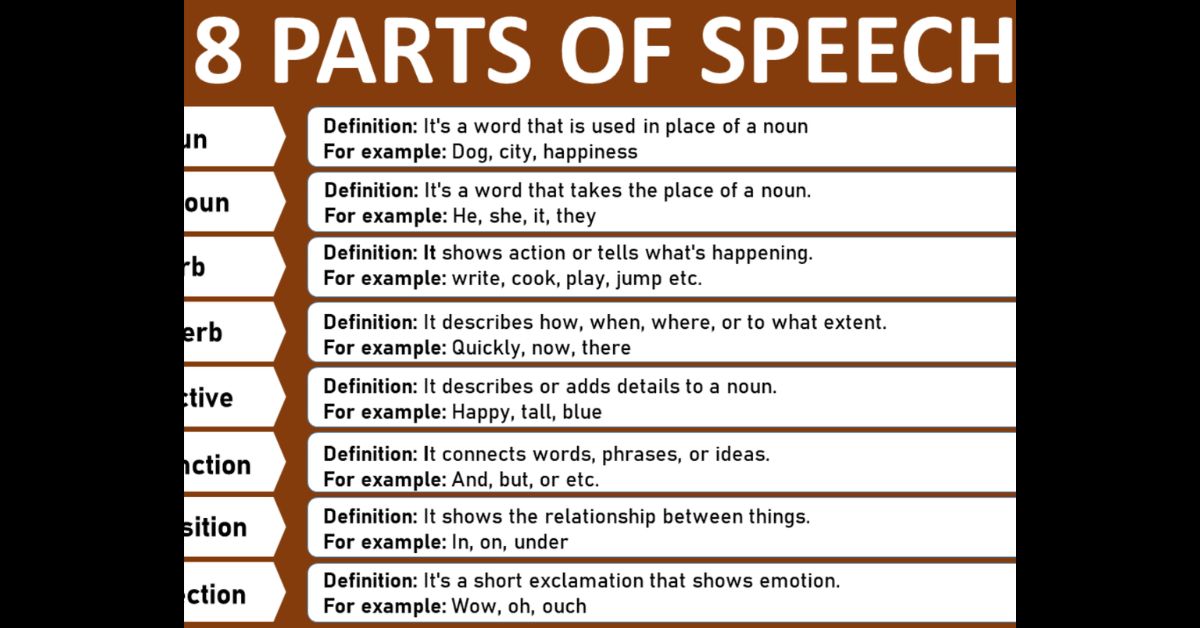
Nouns: Definition and Examples
Nouns are words used to name people, places, objects, or ideas. They are essential to sentence structure, acting as subjects and objects around which actions and descriptions are built.
- Definition: Nouns name tangible and intangible items.
- Example: The cat sat on the mat.
Verbs: Definition and Examples
Verbs are words that express actions or indicate a state of being. They show what the subject does or experiences, adding movement and meaning to a sentence.
- Definition: Verbs express actions or states of being.
- Example: She runs every morning.
Adjectives: Definition and Examples
Adjectives are words that describe or modify nouns by adding more information about their size, shape, color, or overall quality.
- Definition: Adjectives provide additional information about a noun.
- Example: The sky is blue.
Adverbs: Definition and Examples
Adverbs are words that describe verbs, adjectives, or other adverbs by showing how, when, where, or how much an action happens.
- Definition: Adverbs add detail to verbs and sometimes adjectives or other adverbs.
- Example: He sings beautifully.
Pronouns: Definition and Examples
Pronouns take the place of nouns to prevent repetition, helping sentences sound smoother and more concise.
- Definition: Pronouns substitute for nouns to simplify sentences.
- Example: She went to the store.
Prepositions: Definition and Examples
Prepositions explain the relationship between a noun or pronoun and the rest of the sentence, showing position, time, or logical connection.
- Definition: Prepositions link nouns or pronouns to other elements in a sentence.
- Example: The book is on the table.
Conjunctions: Definition and Examples
Conjunctions join words, phrases, or clauses, allowing ideas to be linked and sentences to become more complex and meaningful.
- Definition: Conjunctions join clauses or phrases for more complex expressions.
- Example: She likes tea and coffee.
Interjections: Definition and Examples
Interjections are words or phrases that express sudden emotions or reactions and often stand independently from the rest of a sentence.
- Definition: Interjections communicate emotions or sudden exclamations.
- Example: Wow! That’s amazing.
Identifying Parts of Speech in Sentences
Being able to identify parts of speech in sentences is crucial for understanding texts and enhancing writing skills. Start by finding the subject nouns or pronouns, then identify the verbs that show the action. Notice adjectives and adverbs that add detail, and observe how conjunctions and prepositions connect ideas. Regular practice with these techniques will make sentence structure clearer and strengthen your overall grammar understanding.
Importance of Understanding Parts of Speech
Understanding the parts of speech is essential to mastering English grammar. It supports clear and effective communication, helps avoid common errors such as run-on sentences and unclear modifiers, and provides the skills needed to write with clarity and confidence. This knowledge also improves reading comprehension by making complex texts easier to analyze and understand.
Conclusion
Mastering the parts of speech is an important step toward fluency in English grammar. When you understand how each element functions, you can strengthen your writing, boost reading comprehension, and communicate more clearly and precisely. For deeper grammar knowledge, explore advanced resources or consult detailed grammar guides.
Frequently Asked Questions
What are the 8 parts of speech?
The eight parts of speech include nouns, verbs, adjectives, adverbs, pronouns, prepositions, conjunctions, and interjections. Each one has a distinct function in forming clear and meaningful sentences.
How do you identify parts of speech in a sentence?
Identifying parts of speech means understanding the role each word plays in a sentence. Nouns and pronouns usually act as subjects or objects, verbs express actions or states, adjectives and adverbs describe or modify other words, and conjunctions and prepositions help connect ideas and clarify relationships.
What are examples of each part of speech?
Here are examples of each part of speech: Noun: the cat. Verb: runs. Adjective: blue sky. Adverb: sings beautifully. Pronoun: she. Preposition: on the table. Conjunction: and. Interjection: wow!
Why are parts of speech important?
Understanding parts of speech is essential for clear communication, strong writing, and learning a language. It helps prevent mistakes and ensures that sentences express the intended meaning accurately.