Causative verbs in English are an important part of grammar that help us describe situations where someone makes, lets, or helps another person do something. For example, in dialogue writing topics, you might often come across sentences like “The teacher made the students write an essay” or “She had her brother fix the computer.” These verbs don’t just show the action; they show who caused the action. Understanding causative verbs will make your conversations, stories, and written dialogues more realistic and accurate. In this guide, we’ll explore their meaning, types, and examples so you can start using them with confidence.
What Are Causative Verbs in English?
Causative verbs are verbs that show the cause of an action. They are used to indicate that someone or something is responsible for causing, making, or allowing an action or event to take place. These verbs express the idea that the subject did not act themselves but made someone or something else do it.
For example:
- Cause: “The manager caused the delay.”
- Make: “He made his brother clean the room.”
- Allow: “They allowed the students to leave early.”
In essence, causative verbs help show the connection between the cause and the action that follows. They are commonly used in both casual and formal communication to indicate the agent behind an event.
Structure of Causative Sentences
Causative sentences are used to show that one person makes, asks, or allows another person to act. These sentences typically follow a specific structure.
Subject + causative verb + object + base form/past participle
The most common causative verbs are make, have, get, and let. For example, “She made him cry” (subject + made + object + base verb) or “He had his car washed” (subject + had + object + past participle). Each causative verb slightly changes the meaning, depending on whether the action was forced, requested, or allowed.
Examples of Causative Verbs
Here are 20 causative verbs, each with its meaning and two example sentences:
1. Make – to force or compel someone to do something
The coach made the team run extra laps.
His parents made him apologize.
2. Have to arrange for someone else to do something
I had the mechanic fix my car.
She had her assistant send the emails.
3. Get – to persuade or convince someone to do something
He got his brother to help him clean.
They got the manager to approve the project.
4. Let – to allow someone to do something
She let her kids watch a movie.
He let his friend borrow his notes.
5. Help – to assist someone in doing something
I helped my mom cook dinner.
She helped her friend carry the boxes.
6. Allow – to permit someone to do something
They allowed the students to leave early.
He allowed his dog to sleep on the couch.
7. Force – to make someone do something against their will
The storm forced us to cancel the trip.
They forced him to sign the document.
8. Persuade – to convince someone to do something
She persuaded her friend to join the class.
He persuaded me to try a new restaurant.
9. Convince – to make someone believe or do something
I convinced him to apply for the job.
They convinced the team to change the plan.
10. Cause – to make something happen or someone do something
The noise caused the baby to cry.
His speech caused people to react strongly.
11. Enable – to make it possible for someone to do something
This app enables users to edit photos.
His savings enabled him to buy a house.
12. Require – to demand that someone do something
The job requires applicants to have experience.
Schools require students to attend regularly.
13. Compel – to strongly force someone to do something
The law compels citizens to pay taxes.
She felt compelled to speak out.
14. Permit – to officially allow someone to do something
The teacher permitted phones during break time.
They were permitted to enter the building.
15. Encourage – to give support to someone to do something
Her parents encouraged her to study abroad.
The coach encouraged the team to practice more.
16. Motivate – to inspire someone to take action
His success motivated others to work harder.
The teacher motivated students to do their best.
17. Hire – to employ someone to do a task
I hired a tutor to help with math.
They hired a decorator for the event.
18. Command – to order someone to do something
The officer commanded the troops to march.
He commanded silence in the room.
19. Oblige – to make someone feel responsible for doing something
I was obliged to attend the meeting.
He felt obliged to return the favour.
20. Urge – to strongly advise or push someone to act
Doctors urge patients to quit smoking.
She urged him to speak honestly.
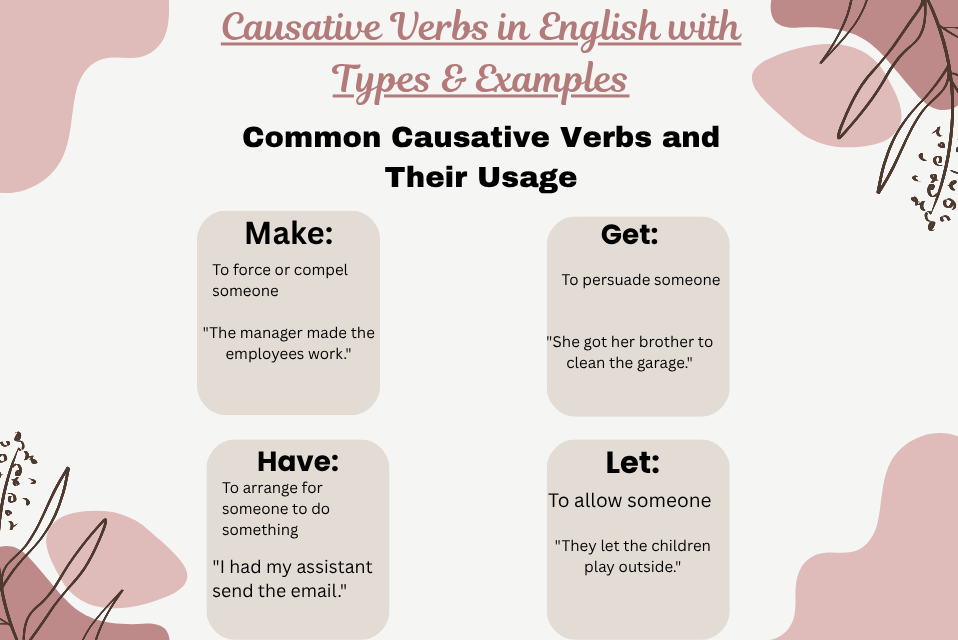
Common Causative Verbs and Their Usage
| Causative Verb | Meaning | Example |
| Make | To force or compel someone | “The manager made the employees work.” |
| Have | To arrange for someone to do something | “I had my assistant send the email.” |
| Get | To persuade someone | “She got her brother to clean the garage.” |
| Let | To allow someone | “They let the children play outside.” |
Using Causative Verbs in Sentences. Causative verbs are typically used in sentences with two objects: the subject (who causes the action) and the object (who acts).
Example:
- “John got his car washed by the mechanic.”
- “She made her brother study for the test.”
Sentence examples of Causative Verbs
Here are 20 examples of causative verbs used in sentences:
1. She made her son clean his room.
2. The teacher made the students write the essay again.
3. I had my car washed yesterday.
4. We had the electrician fix the lights.
5. He got his friend to help with the homework.
6. They got the mechanic to repair the engine.
7. She let her children play outside.
8. He let his friend borrow his phone.
9. I helped my brother paint the house.
10. She helped her mom cook dinner.
11. The manager made the staff work overtime.
12. They had their house painted last week.
13. He got the waiter to bring another glass of water.
14. She let the cat sleep on the bed.
15. The mother made her child eat vegetables.
16. I got my laptop repaired at the shop.
17. They had the windows cleaned by professionals.
18. She helped me understand the math problem.
19. He let his little sister watch cartoons.
20. We got our documents printed at the copy shop.
Conclusion
Causative verbs in English allow us to clearly show when someone causes, permits, or helps another person act. Mastering their structure and usage will not only improve your grammar but also make your dialogues and conversations more expressive. As you continue practicing, try applying them with different verbs for example, the verb “drop” (V1, V2, V3) to see how causative forms work in real sentences. With steady practice, you’ll build confidence and accuracy in both writing and speaking.
Frequently Asked Questions
1. What is a causative verb in English?
A causative verb shows that the subject causes someone else to do something. It doesn’t act directly, but makes it happen.
2. What are the most common causative verbs?
The most commonly used causative verbs in English are: make, have, get, let, and help.
3. What is the structure of a causative sentence with “make”?
Structure: [Subject] + make + [person] + [base verb]
Example: “She made him cry.”