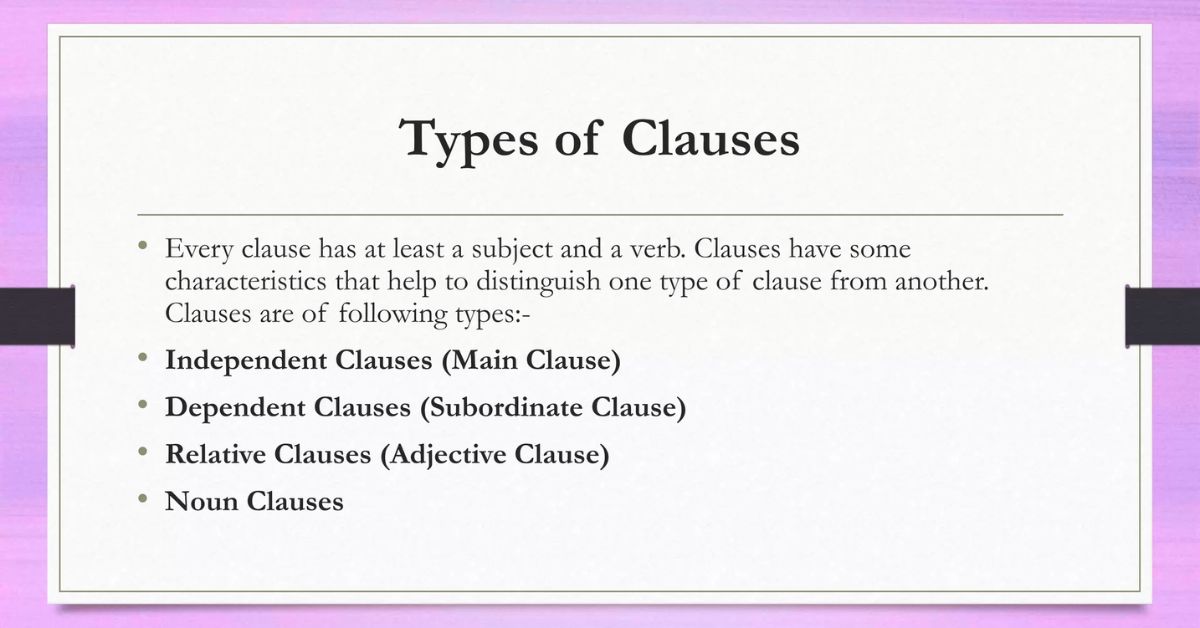
Clauses and Their Types: Clauses are one of the most important building blocks of English grammar. A clause is a group of words that contains a subject and a verb, and it expresses a complete or incomplete thought. Understanding clauses helps you form clear sentences, avoid grammar mistakes, and improve both your writing and speaking skills. In English, clauses are mainly divided into independent (main) clauses and dependent (subordinate) clauses.
Dependent clauses are further classified into noun clauses, adjective clauses, and adverb clauses. Learning the different types of clauses and how they function in sentences will make your grammar stronger and your communication more effective.
Definition of Clauses and their Types:
Clauses are an essential part of language and are commonly defined as groups of words that include both a subject and a verb. They act as the foundation of sentences, helping us express ideas and emotions clearly and effectively. By understanding and using clauses correctly, writers can create richer descriptions and communicate with greater depth and precision.
Additionally, clauses can be classified as independent or dependent, with each type serving a distinct function in sentence structure.
- Independent Clauses
- Dependent Clauses
- Adjective Clauses
- Adverbial Clauses
- Noun Clauses
Independent Clauses
An independent clause is a group of words that expresses a complete thought and can stand alone as a sentence. For example, “The sun set behind the mountains” is an independent clause because it does not need extra information to make sense. Learning about independent clauses is important for improving sentence structure and strengthening your writing style.
Independent clauses create compound sentences:
When independent clauses are joined using coordinating conjunctions such as “and,” “but,” or “or,” they form compound sentences that make writing more engaging. For instance, “The sun set behind the mountains, and the stars began to twinkle” combines two complete ideas into one smooth sentence. This structure adds variety and flow while enhancing meaning. Understanding how independent clauses work together can turn simple statements into more expressive writing and improve overall clarity in communication.
Dependent Clauses:
Dependent clauses are key elements of language that add detail and meaning to sentences. They are groups of words that contain a subject and a verb but cannot stand alone as complete sentences because they depend on independent clauses. For example, in the sentence “Although it was raining, we decided to go for a walk,” the phrase “Although it was raining” is a dependent clause.
Dependent clauses help show relationships between ideas by expressing time, reason, condition, or contrast. This adds depth and clarity to communication. For instance, in the sentence “If you study hard, you’ll pass the exam,” the dependent clause “If you study hard” introduces a condition while also creating an encouraging tone.
Adjective Clauses:
Adjective clauses, also called relative clauses, are important parts of sentence structure. They are groups of words that include a subject and a verb and usually begin with relative pronouns such as “who,” “which,” or “that.” For example, in the sentence “The book that I borrowed from the library was thrilling,” the clause “that I borrowed from the library” provides additional information about the book.
Adjective clauses help combine ideas smoothly and add clarity without needing extra sentences. For instance, in the sentence “The artist who painted the mural is renowned for her innovative techniques,” the clause “who painted the mural” identifies the artist and creates interest in her work and creative style.
Adverbial Clauses:
Adverbial clauses add clarity and detail to sentences by providing extra information about actions. These subordinate clauses modify verbs, adjectives, or other adverbs and explain aspects such as reason, time, condition, or manner. For example, in the sentence “She danced gracefully because she was filled with joy,” the clause “because she was filled with joy” gives the reason for her graceful dancing and adds emotional depth to the statement.
A key feature of adverbial clauses is their ability to show relationships between actions and situations. They can express time, cause, condition, or contrast, helping writers communicate ideas more effectively. For instance, in the sentence “Although it was raining, we decided to go for a hike,” the clause “Although it was raining” presents a contrast and highlights determination despite challenging circumstances.
Noun Clauses:
Noun clauses are important elements of complex sentences. A noun clause is a dependent clause that functions as a subject, object, or complement within a sentence. For example, in the sentence “What she said surprised everyone,” the noun clause “What she said” acts as the subject, showing how noun clauses can convey meaningful information while adding complexity to sentence structure.
Noun clauses often express thoughts, ideas, or questions that move communication forward. For instance, in the sentence “I don’t know whether he will attend the meeting,” the noun clause “whether he will attend the meeting” provides key information about uncertainty and helps create curiosity within the sentence.
Conclusion
In conclusion, clauses play a vital role in English grammar by forming the structure and meaning of sentences. Understanding the difference between independent and dependent clauses, along with specific types such as noun, adjective, and adverb clauses, helps learners create clearer and more expressive sentences.
Mastering clauses not only improves grammar accuracy but also enhances writing style and communication skills. By practicing how different clauses function together, you can confidently construct complex sentences and convey ideas with greater clarity and effectiveness.
Frequently Asked Questions
1. What is a clause in English grammar?
A clause is a group of words that contains a subject and a verb. It can express a complete thought (independent clause) or an incomplete thought (dependent clause).
2. What are the main types of clauses?
The main types of clauses are independent clauses and dependent clauses. Dependent clauses are further divided into noun clauses, adjective clauses, and adverb clauses.
3. What is the difference between an independent and a dependent clause?
An independent clause can stand alone as a complete sentence, while a dependent clause cannot stand alone and must be connected to an independent clause.
4. What is a noun clause with an example?
A noun clause is a dependent clause that acts as a noun in a sentence. For example, “What she said made everyone laugh,” where “What she said” functions as the subject.
5. Why are clauses important in writing?
Clauses are important because they help form sentences, express detailed ideas, and improve clarity and variety in writing and speaking.