Every writer , from students to seasoned professionals , has at least once paused mid-sentence and thought:
“Wait… is it weather or whether?”
You’re not alone. These two words sound exactly the same (homophones), look similar, and appear frequently in everyday writing. And just when you feel confident, a third sneaky one enters the confusion list: wether , a word 99% of people don’t even know exists. By the end, you’ll never confuse these three again , and your writing will look cleaner, more professional, and more confident.
Quick Answer: What’s the Difference? (Cheat Sheet)
Let’s start with the shortest version:
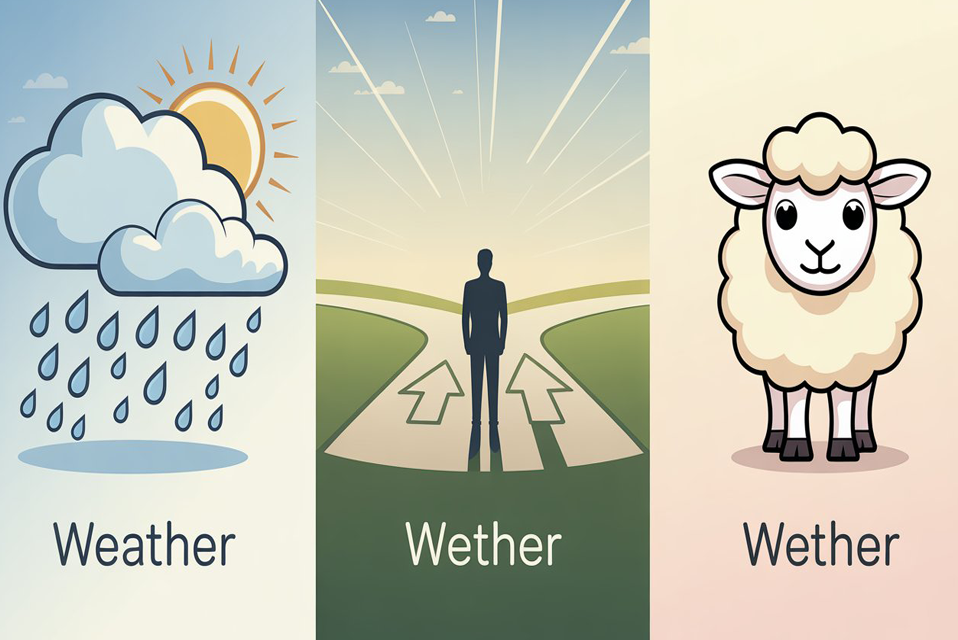
- Weather → Noun: atmospheric conditions (rain, sun, temperature, wind).
Also a verb meaning “to endure or survive something.” - Whether → Conjunction: introduces choices, alternatives, doubt, or possibilities.
- Wether → Noun: a castrated male sheep (a rare word, mostly used in farming).
Here’s the fast table that helps people instantly choose the correct word:
| Word | Part of Speech | Meaning | Use When Talking About… | Example |
| weather | noun / verb | climate, atmospheric conditions / to endure | rain, sun, wind, storms, survival | “The weather is cold today.” / “They weathered the storm.” |
| whether | conjunction | choice, alternatives, uncertainty | decisions, options, doubt | “I can’t decide whether to stay or go.” |
| wether | noun | castrated sheep | farming, livestock | “The farmer bought a new wether.” |
What Does “Weather” Mean? (Noun + Verb Explained)
Weather as a Noun: Atmospheric Conditions
This is the meaning almost everyone knows.
Weather (noun) refers to:
- Rain
- Sunshine
- Storms
- Temperature
- Clouds
- Climate
- Wind
- Snow
- Atmospheric pressure
- Humidity
If it relates to what’s happening in the sky or the air, it’s weather.
Examples:
- “The weather today is warm and sunny.”
- “Bad weather caused flight delays.”
- “We’re expecting stormy weather this evening.”
If are interested to learn about gender based noun read our guide to Gender Nouns .
Weather as a Verb: To Endure or Survive Something
This meaning is less common, but extremely useful. Weather (verb) means:
- to survive
- to endure
- to withstand hardship
- to get through a difficult situation
Often used metaphorically.
Examples:
- “They weathered the economic crisis.”
- “The old boat weathered the storm surprisingly well.”
- “We’ll weather whatever challenges come our way.”
Common Mistakes with “Weather”
- Using it when talking about choices (“I’m deciding weather to go.”)
- Confusing the verb “weather” with “whether” (e.g., “weather or not you come…”)
To fix this, use this test:
Ask yourself: Am I talking about the sky or surviving something? If yes → weather.
If no → move on to “whether.”
What Does “Whether” Mean? (Conjunction for Choices)
Whether is a conjunction. That means it connects ideas , specifically choices or alternatives.
Use whether when:
- You’re unsure
- You’re choosing between two or more things
- You’re expressing doubt
- You’re presenting possibilities
- You need the pattern: “whether… or…”
Examples:
- “I can’t decide whether to order pizza or sushi.”
- “Let me know whether you’re coming.”
- “We’re discussing whether the plan will work.”
- “I’m wondering whether or not we should go.”
“Whether” vs “If”
A big grammar confusion. You can use if for conditions. But use whether for choices or alternatives.
Examples:
- “I don’t know whether he’ll come.” (choice, uncertainty)
- “If it rains, we’ll stay home.” (condition)
You CANNOT always replace “whether” with “if.”
Common Mistakes with Whether
Wrong: “Weather you like it or not…”
Correct: “Whether you like it or not…”
Wrong: “Tell me if or not you’re going.”
Correct: “Tell me whether or not you’re going.”
Use this test:
Am I offering alternatives or doubt? If yes → choose whether.
What Does “Wether” Mean? (The Rare Third Word Most People Don’t Know)
Wether is:
- a noun
- refers to a castrated male sheep
- used mostly in farming, livestock, and agricultural contexts
Examples:
- “The shepherd purchased a young wether.”
- “A wether is calmer than a ram.”
- “Breeders often keep a few wethers for grazing.”
Comparison Table: Weather vs Whether vs Wether
| Feature | Weather | Whether | Wether |
| Sound | same as “whether” | same as “weather” | same as both |
| Part of Speech | noun / verb | conjunction | noun |
| Meaning | climate or endure | choices or uncertainty | castrated sheep |
| Related Entities | rain, sun, climate, wind, storms, temperature, atmosphere | alternatives, doubt, options | livestock, farming |
| Example | “The weather is cold.” | “I don’t know whether to go.” | “The wether grazed quietly.” |
Easy Memory Tricks (Mnemonics)
WEATHER → think “sky & climate”
Weather has ea, like:
- clear sky
- measure temperature
OR use the “sky test”:
If it’s in the sky → it’s weather.
WHETHER → think “choice/h-option”
Whether contains an h , think “H = choice”. Two options: Here or there → here / there → whe ther
Another trick is that Whether introduces whether or not. The “or not” belongs to whether , not weather.
WETHER → think “animal”
Wether rhymes with “tether” → farm animals on a tether.Or simply:
Wether = sheep (and nothing else).
Common Confusions & Why Writers Mix These Words Up
- They are perfect homophones , identical pronunciation.
- Spell-check often doesn’t catch the error if the wrong word is still a valid word.
- People default to “weather” because it’s more common.
- Most aren’t aware “wether” even exists.
- Quick writing → muscle memory mistakes.
Bad examples vs correct versions:
Wrong: “I don’t know weather he’ll come.”
Correct: “I don’t know whether he’ll come.”
Wrong: “We will weather or not attend.”
Correct: “We will whether or not attend.”
Wrong: “The whether is cold today.”
Correct: “The weather is cold today.”
Example Sentences (All Meanings, All Words)
Weather (noun)
- “The weather forecast says it will rain.”
- “Cold weather affects my mood.”
- “The beach is beautiful in warm weather.”
Weather (verb)
- “They weathered tough times together.”
- “The cabin weathered decades of storms.”
- “We’ll weather the ups and downs.”
Whether (conjunction)
- “I’m unsure whether to study or rest.”
- “Tell me whether he replied.”
- “Decide whether or not you’re joining us.”
Wether (noun)
- “The wether followed the herd.”
- “Farmers sometimes raise wethers for grazing.”
- “A wether is calmer than a ram.”
Mini Quiz: Test Yourself by Fill in the blanks
whether
weather
weathered
whether
wether
whether
Etymology (Word Origins)
Here is the origin details:
WEATHER (Old English “weder”)
Means:
- air
- sky
- storm
- breeze
Connected to German Wetter and Dutch weder.
WHETHER (Old English “hwæþer”)
Meaning:
- which of two
- either of the two
- choice
Originally used in questions: “Hwæþer will you choose?”
WETHER (Old English “wether”)
Meaning:
- ram
- male sheep
Same word in German: Widder.
When to Use Each Word in Everyday Writing
In Emails:
- “Please confirm whether you’ll attend.”
- “Due to bad weather, the meeting is postponed.”
In Academic Writing:
- “The study examines whether environmental factors influence behavior.”
- “Extreme weather patterns are increasing.”
In Fiction:
- “He wondered whether the truth mattered.”
- “The sailors weathered the violent storm.”
In Business:
- “We must decide whether to expand.”
- “Severe weather caused shipping delays.”
Related Confusing Word Pairs
- Affect vs Effect
- Then vs Than
- Your vs You’re
- Their vs There vs They’re
- Principle vs Principal
- Accept vs Except
Summary: How to Always Choose the Right Word
Here’s your 3-step rule:
- Talking about climate or surviving something? → weather
- Talking about choices or alternatives? → whether
- Talking about sheep? → wether
And that’s it , you’ll never get confused again.
Conclusion
“Weather,” “whether,” and “wether” are identical in sound but dramatically different in meaning.
Most confusion comes simply from familiarity (weather is common), sound similarity, and typing quickly. But now you know:
- the atmospheric entities that define weather
- the grammatical function of whether
- the agricultural meaning of wether
- usage examples
- memory tricks
- and the difference between choices, climate, and livestock
Frequently Asked Questions (FAQs)
Is it “weather or not” or “whether or not”?
Use “whether or not” because it expresses choices, while weather refers to climate.
Can I replace “whether” with “if”?
Sometimes you can use “if”, but not when clearly showing choices like “whether or not.”
Why do weather and whether sound the same?
They sound identical because they are homophones with different meanings.
Is “wether” ever used today?
Yes, “wether” is still used in farming and livestock breeding, but rare in normal writing.