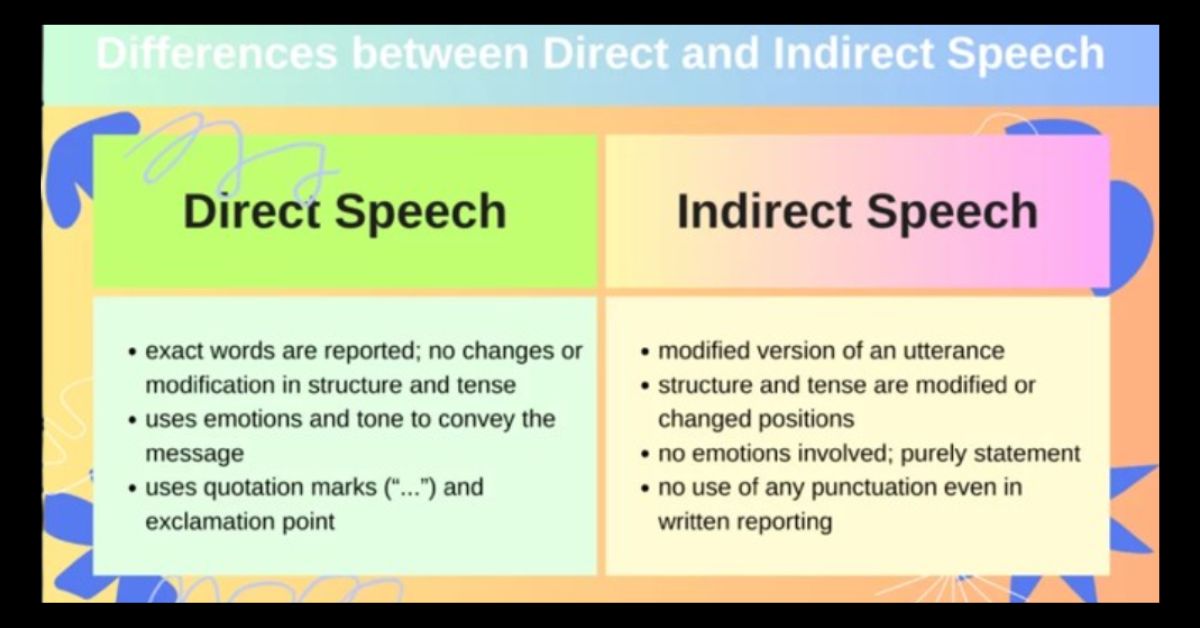
Direct and indirect speech are essential ways to express ideas, thoughts, and emotions in communication. Direct speech repeats the exact words spoken, helping readers feel present in the moment and clearly understand a character’s emotions. For example, an excited exclamation feels more vivid when quoted directly rather than briefly summarized.
In contrast, indirect speech reports what was said without using the speaker’s exact words. It highlights the message’s overall meaning and context, allowing the writer to focus on interpretation, such as expressing surprise or disbelief at an achievement.
Examples
Here is a list of direct and indirect speech examples that include statements, questions, commands, requests, and exclamations.
- Direct: He said, “I am happy.”
- Indirect: He said that he was happy.
- Direct: She said, “I like coffee.”
- Indirect: She said that she liked coffee.
- Direct: They said, “We are going to the market.”
- Indirect: They said that they were going to the market.
- Direct: John said, “I will call you tomorrow.”
- Indirect: John said that he would call me the next day.
- Direct: She said, “I can’t swim.”
- Indirect: She said that she couldn’t swim.
- Direct: He said, “I have finished my work.”
- Indirect: He said that he had finished his work.
- Direct: They said, “We were playing football.”
- Indirect: They said that they had been playing football.
- Direct: I said, “I will help you.”
- Indirect: I said that I would help you.
- Direct: He said, “I may come late.”
- Indirect: He said that he might come late.
- Direct: She said, “I must study now.”
- Indirect: She said that she had to study then.
- Direct: He said, “I was working all day.”
- Indirect: He said that he had been working all day.
- Direct: She said, “I don’t like chocolate.”
- Indirect: She said that she didn’t like chocolate.
- Direct: They said, “We have eaten already.”
- Indirect: They said that they had already.
- Direct: He said, “I am going to the gym.”
- Indirect: He said that he was going to the gym.
- Direct: She said, “I didn’t see him.”
- Indirect: She said that she hadn’t seen him.
- Direct: He said, “I could run faster before.”
- Indirect: He said that he could run faster before.
- Direct: She said, “I should go now.”
- Indirect: She said that she should go then.
- Direct: They said, “We would love to join.”
- Indirect: They said that they would love to join.
- Direct: He said, “I need a break.”
- Indirect: He said that he needed a break.
- Direct: She said, “I’m watching a movie.”
- Indirect: She said that she was watching a movie.
- Direct: He said, “I’ve been to London.”
- Indirect: He said that he had been to London.
- Direct: She said, “I am writing a letter.”
- Indirect: She said that she was writing a letter.
- Direct: They said, “We want to learn English.”
- Indirect: They said that they wanted to learn English.
- Direct: He said, “I don’t know the answer.”
- Indirect: He said that he didn’t know the answer.
- Direct: She said, “I am feeling tired.”
- Indirect: She said that she was feeling tired.
- Direct: He said, “We are leaving now.”
- Indirect: He said that they were leaving then.
- Direct: They said, “We saw the match yesterday.”
- Indirect: They said that they had seen the match the day before.
- Direct: She said, “I will try again.”
- Indirect: She said that she would try again.
- Direct: He said, “I can speak Spanish.”
- Indirect: He said that he could speak Spanish.
- Direct: She said, “I might be late.”
- Indirect: She said that she might be late.
- Direct: He said, “I eat fruit daily.”
- Indirect: He said that he ate fruit daily.
- Direct: She said, “It is raining.”
- Indirect: She said that it was raining.
- Direct: They said, “We need water.”
- Indirect: They said that they needed water.
- Direct: He said, “I met her last week.”
- Indirect: He said that he had met her the week before.
- Direct: She said, “My brother is a doctor.”
- Indirect: She said that her brother was a doctor.
- Direct: He said, “I do not trust him.”
- Indirect: He said that he did not trust him.
- Direct: She said, “I enjoy painting.”
- Indirect: She said that she enjoyed painting.
- Direct: He said, “We have won the game.”
- Indirect: He said that they had won the game.
- Direct: She said, “I slept late.”
- Indirect: She said that she had slept late.
- Direct: He said, “I am learning French.”
- Indirect: He said that he was learning French.
- Direct: She said, “I’ll see you soon.”
- Indirect: She said that she would see me soon.
- Direct: He said, “I hate noise.”
- Indirect: He said that he hated noise.
- Direct: They said, “We are hungry.”
- Indirect: They said that they were hungry.
- Direct: She said, “I forgot my keys.”
- Indirect: She said that she had forgotten her keys.
- Direct: He said, “The dog barked at me.”
- Indirect: He said that the dog had barked at him.
- Direct: She said, “I want to dance.”
- Indirect: She said that she wanted to dance.
- Direct: He said, “I visited Lahore.”
- Indirect: He said that he had visited Lahore.
- Direct: She said, “He was kind to me.”
- Indirect: She said that he had been kind to her.
- Direct: He said, “I’m ready.”
- Indirect: He said that he was ready.
- Direct: She said, “My friends helped me.”
- Indirect: She said that her friends had helped her.
- Direct: He asked, “Where are you going?”
- Indirect: He asked where I was going.
- Direct: She asked, “What is your name?”
- Indirect: She asked what my name was.
- Direct: They asked, “How old are you?”
- Indirect: They asked how old I was.
- Direct: He asked, “Why are you late?”
- Indirect: He asked why I was late.
- Direct: She asked, “When did he leave?”
- Indirect: She asked when he had left.
- Direct: He asked, “Do you like tea?”
- Indirect: He asked if I liked tea.
- Direct: She asked, “Did you see the movie?”
- Indirect: She asked if I had seen the movie.
- Direct: They asked, “Can you help us?”
- Indirect: They asked if I could help them.
- Direct: He asked, “Will you come tomorrow?”
- Indirect: He asked if I would come the next day.
- Direct: She asked, “Have you eaten?”
- Indirect: She asked if I had eaten.
- Direct: He asked, “Is she at home?”
- Indirect: He asked if she was at home.
- Direct: They asked, “Are you okay?”
- Indirect: They asked if I was okay.
- Direct: She asked, “Was he crying?”
- Indirect: She asked if he had been crying.
- Direct: He asked, “Can I join the group?”
- Indirect: He asked if he could join the group.
- Direct: She asked, “May I leave now?”
- Indirect: She asked if she might leave then.
- Direct: He asked, “Shall I open the window?”
- Indirect: He asked if he should open the window.
- Direct: They asked, “Has she come back?”
- Indirect: They asked if she had come back.
- Direct: He asked, “Did she call you?”
- Indirect: He asked if she had called me.
- Direct: She asked, “Is it raining outside?”
- Indirect: She asked if it was raining outside.
- Direct: He asked, “Have you done your homework?”
- Indirect: He asked if I had done my homework.
- Direct: He said, “Close the door.”
- Indirect: He told me to close the door.
- Direct: She said, “Don’t make noise.”
- Indirect: She told me not to make noise.
- Direct: They said, “Please help us.”
- Indirect: They requested me to help them.
- Direct: He said, “Sit down.”
- Indirect: He told me to sit down.
- Direct: She said, “Don’t touch it.”
- Indirect: She told me not to touch it.
- Direct: He said, “Open your book.”
- Indirect: He told me to open my book.
- Direct: She said, “Call the doctor.”
- Indirect: She told me to call the doctor.
- Direct: He said, “Don’t forget to pay the bill.”
- Indirect: He reminded me not to forget to pay the bill.
- Direct: They said, “Let us go home.”
- Indirect: They suggested that they should go home.
- Direct: She said, “Please be quiet.”
- Indirect: She requested me to be quiet.
- Direct: He said, “Don’t run in the hall.”
- Indirect: He told me not to run in the hall.
- Direct: She said, “Bring me a glass of water.”
- Indirect: She told me to bring her a glass of water.
- Direct: He said, “Let him finish his work.”
- Indirect: He allowed him to finish his work.
- Direct: She said, “Please take a seat.”
- Indirect: She requested me to take a seat.
- Direct: He said, “Don’t be late.”
- Indirect: He told me not to be late.
- Direct: He said, “What a beautiful day!”
- Indirect: He exclaimed that it was a beautiful day.
- Direct: She said, “How smart you are!”
- Indirect: She exclaimed that I was very smart.
- Direct: He said, “What a mess!”
- Indirect: He exclaimed that it was a mess.
- Direct: She said, “How lovely the flowers are!”
- Indirect: She exclaimed that the flowers were lovely.
- Direct: He said, “Alas! I am ruined.”
- Indirect: He exclaimed with sorrow that he was ruined.
- Direct: She said, “Hurrah! We won!”
- Indirect: She exclaimed with joy that they had won.
- Direct: He said, “Wow! That’s amazing!”
- Indirect: He exclaimed with wonder that it was amazing.
- Direct: She said, “Oh! I forgot my bag.”
- Indirect: She exclaimed with surprise that she had forgotten her bag.
- Direct: He said, “Bravo! You did it!”
- Indirect: He applauded me, saying that I had done it.
- Direct: She said, “Oh dear! I broke the vase.”
- Indirect: She exclaimed with regret that she had broken the vase.
- Direct: He said, “Fie! You lied to me!”
- Indirect: He expressed disgust that I had lied to him.
- Direct: She said, “What a terrible idea!”
- Indirect: She exclaimed that it was a terrible idea.
- Direct: He said, “Oh no! My phone is missing!”
- Indirect: He exclaimed with fear that his phone was missing.
- Direct: She said, “Yay! It’s my birthday!”
- Indirect: She exclaimed with joy that it was her birthday.
- Direct: He said, “Ouch! That hurts!”
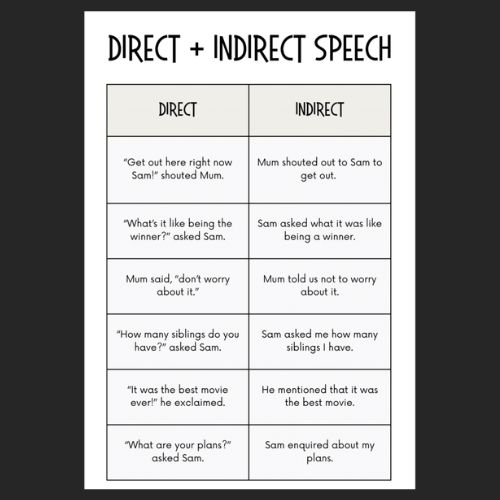
Differences Between Direct and Indirect Speech
| Differences | Direct Speech | Indirect Speech |
|---|---|---|
| Definition | Exact words spoken are quoted. | The spoken words are reported using your own words. |
| Quotation Marks | Uses quotation marks (“ ”). | Does not use quotation marks. |
| Tense Change | Tense remains the same as spoken. | Tense usually changes (backshifted one step). |
| Pronoun Change | Pronouns stay the same as the speaker said. | Pronouns change based on the speaker and listener. |
| Reporting Verb | Often uses “said” or “asked” after the sentence. | Uses “said that,” “told,” “asked,” etc., before the report. |
| Time Expressions | Uses actual time words: now, today, tomorrow. | Time words change: now → then, today → that day, etc. |
| Punctuation | Needs a comma before the quote and punctuation inside. | No comma or inner punctuation needed. |
| Formality | Sounds more personal or dramatic. | Sounds more formal and neutral. |
| Example | She said, “I am tired.” | She said that she was tired. |
| Usage | Used in dialogues, stories, or drama. | Used in reports, news, and factual writing. |
Frequently Asked Questions
What is direct speech?
Direct speech is used when you repeat a speaker’s exact words, usually written inside quotation marks.
What is indirect speech?
Indirect speech, also called reported speech, explains what someone said without using their exact words and usually involves changes in sentence structure and verb tense.
Can you provide an example of direct speech?
Here is an example of direct speech: Sarah said, “I love reading books.”
Can you provide an example of indirect speech?
Here is an example of indirect speech: Sarah said that she loved reading books.
How do I change a sentence from direct to indirect speech?
To convert direct speech into indirect speech, remove the quotation marks, modify the verb tense, and adjust pronouns when needed.