Many English learners find the word “had” confusing because it appears in different grammar structures. Sometimes it shows possession, sometimes it forms the past perfect tense, and other times it is used in conditional sentences.
Learning how to use had correctly is important because it helps you describe past events accurately and communicate more naturally. In this guide, you will learn the rules, examples, common mistakes, exercises, and frequently asked questions about using had in English grammar.
What Is “Had” in English Grammar?
Had is the past tense and past participle form of the verb have.
It can be used:
- As a main verb
- As a helping (auxiliary) verb
- In past perfect tense
- In conditional sentences
- In reported speech
- In expressions like “had better”
Examples
- I had a bicycle when I was young.
- She had finished her homework before dinner.
- If I had known, I would have helped you.
Uses of “Had” in English Grammar
1. Had as a Main Verb
When used as a main verb, had shows possession, ownership, experience, or obligation in the past.
Examples
- I had a red bicycle.
- They had a large house.
- We had a wonderful vacation.
- She had a headache yesterday.
- He had to leave early.
Structure
Subject + Had + Object
Examples:
- She had a dog.
- We had enough food.
2. Had in the Past Perfect Tense
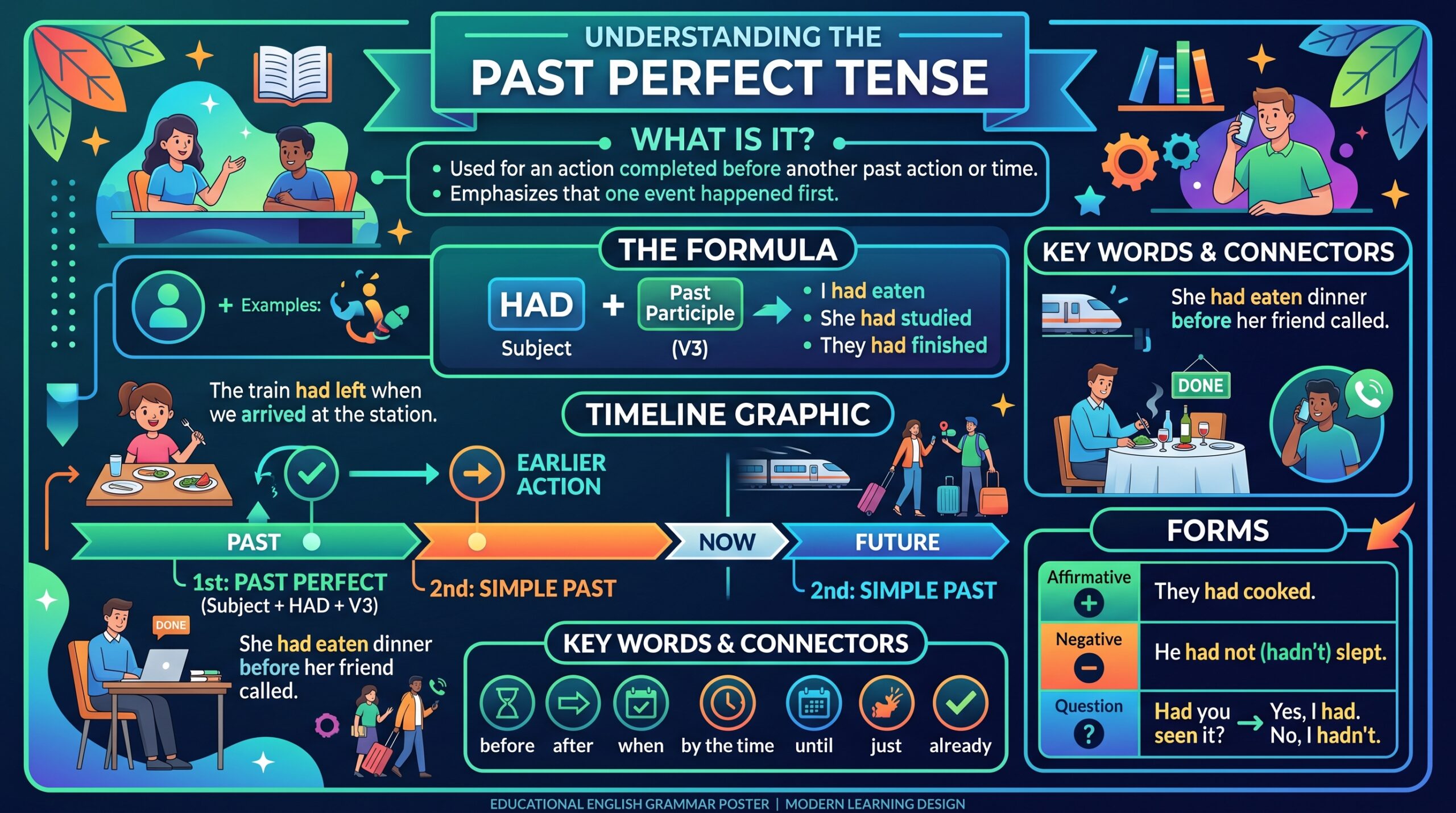
One of the most important uses of had is forming the past perfect tense.
Formula
Subject + Had + Past Participle
Examples
- She had finished her project before the deadline.
- They had left before we arrived.
- I had eaten dinner before the movie started.
- He had completed the task before lunch.
- We had never seen snow before that trip.
Why Use Past Perfect?
The past perfect shows that one action happened before another action in the past.
Example
- When I arrived, the train had already left.
The train left first. Then I arrived.
3. Had in Conditional Sentences
The word had is commonly used in the third conditional, which talks about unreal situations in the past.
Structure
If + Subject + Had + Past Participle
Would Have + Past Participle
Examples
- If I had studied harder, I would have passed the exam.
- If she had called me, I would have answered.
- If they had arrived earlier, they would have caught the train.
- If we had known the truth, we would have acted differently.
These situations never actually happened.
4. Had in Reported Speech
When reporting someone’s words, have and has often change to had.
Direct Speech
- She said, “I have a new car.”
Reported Speech
- She said she had a new car.
More examples:
- He said he had a meeting.
- They told us they had enough money.
- She explained that she had completed the assignment.
5. Had Better for Advice
The phrase had better is used to give strong advice or warnings.
Structure
Subject + Had Better + Base Verb
Examples
- You had better study for the exam.
- We had better leave now.
- He had better apologize.
- They had better be careful.
- She had better take an umbrella.

How to Use Had Correctly
Follow these simple steps:
Step 1: Check the Time
If you’re talking about the past, determine whether one action happened before another.
Step 2: Use Past Perfect When Necessary
If one past action happened before another past action:
- Use had + past participle
Example:
- She had left before I arrived.
Step 3: Use Had for Possession
When talking about owning or experiencing something in the past:
- Use had as the main verb.
Example:
- I had a pet rabbit.
Step 4: Use Had in Third Conditional Sentences
When imagining a different past result:
- Use If + had + past participle
Example:
- If I had listened, I would have understood.
Examples of Had in Sentences
Here are more examples to help you understand.
Past Possession
- I had many toys as a child.
- She had a beautiful garden.
Past Perfect
- They had already finished eating.
- We had completed the project.
Conditional
- If he had practiced more, he would have won.
- If we had left earlier, we would have arrived on time.
Reported Speech
- She said she had a busy day.
- He explained that he had lost his keys.
Advice
- You had better stop wasting time.
- We had better call the doctor.
Common Mistakes with Had
Mistake 1: Using Had for a Single Past Action
I had visited London last year.
I visited London last year.
Explanation:
For a simple completed action, use the simple past tense.
Mistake 2: Using Would Have in the If-Clause
If I would have known, I would have helped.
If I had known, I would have helped.
Mistake 3: Forgetting Had in Past Perfect
She never seen snow before moving there.
She had never seen snow before moving there.
Mistake 4: Confusing Had and Have
Yesterday I have a meeting.
Yesterday I had a meeting.
Mistake 5: Using Had Better Incorrectly
You better study.
You had better study.
Quick Summary
- Had is the past form of have.
- Use had to talk about possession in the past.
- Use had + past participle for the past perfect tense.
- Use had in third conditional sentences.
- Use had better for strong advice.
- Avoid using past perfect when simple past is enough.
Practice Exercises
Fill in the blanks with the correct form.
Exercise 1
By the time I arrived, they _____ already left.
Exercise 2
If she _____ studied harder, she would have passed.
Exercise 3
We _____ a wonderful holiday last year.
Exercise 4
You _____ better finish your homework.
Exercise 5
He _____ never visited Paris before that trip.
Answers
- had
- had
- had
- had
- had
Frequently Asked Questions
What is the difference between “had” and “have”?
Have is used in the present tense.
Example:
- I have a car.
Had is used in the past tense.
Example:
- I had a car.
What is the difference between “had” and “had had”?
In had had, the first had is the helping verb and the second had is the past participle of have.
Example:
- She had had enough problems before she moved.
Can I use had without another verb?
Yes.
When showing possession or experience:
- I had a bicycle.
- We had fun.
When should I use the past perfect tense?
Use it when one action happened before another action in the past.
Example:
- She had left before I arrived.
Is “had better” formal?
No. It is common in everyday English and is used to give strong advice or warnings.
Example:
- You had better be careful.
Conclusion
Understanding how to use had correctly is an important step in improving your English grammar. Whether you are talking about past possession, describing actions in the past perfect tense, reporting speech, or creating conditional sentences, had plays a crucial role.
Practice using had in everyday conversations and writing. The more you use it, the more natural and confident your English will become.