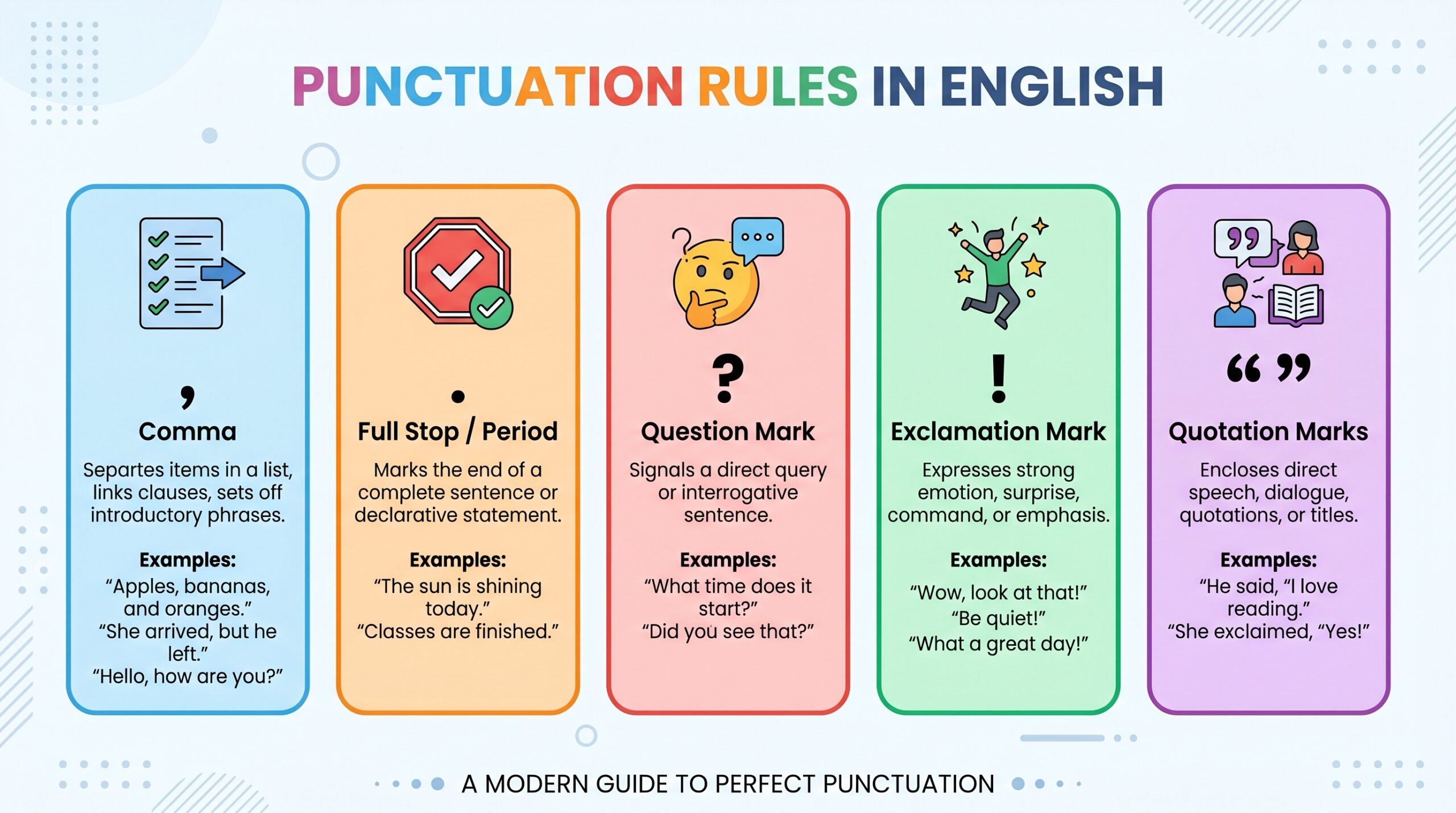
Punctuation is an essential part of English writing. It helps make your sentences clear, meaningful, and easy to understand. Without punctuation, writing can become confusing and difficult to read.
In this guide, you’ll learn important punctuation rules, meanings, and simple examples to improve your grammar and writing skills.
What is Punctuation?
Punctuation marks are symbols used in writing to show:
- Pauses
- Stops
- Questions
- Emotions
👉 They help organize sentences and improve readability.
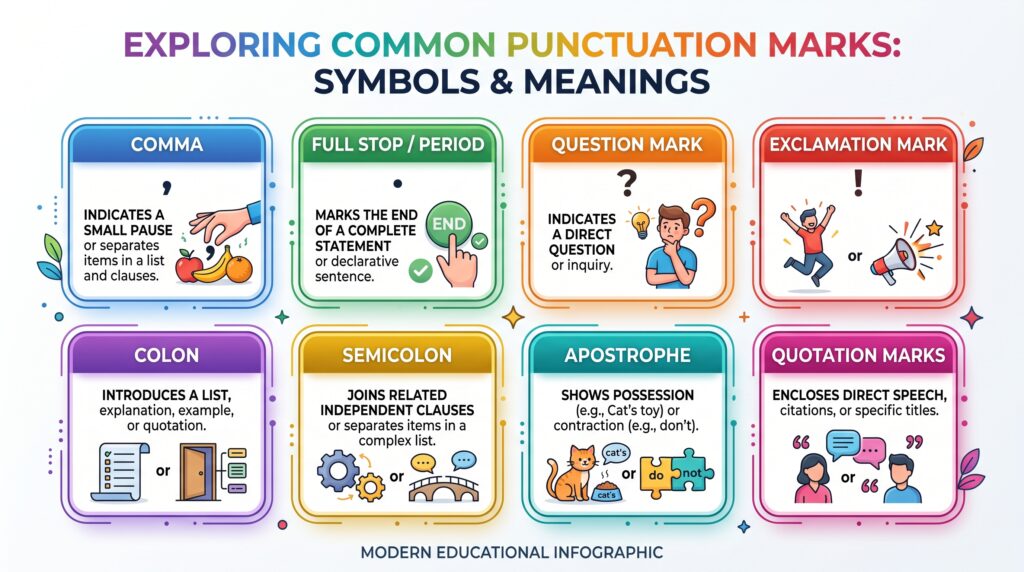
Common Punctuation Marks with Examples
1. Full Stop (.)
Used to end a sentence
✅ Example:
- She is reading a book.
2. Question Mark (?)
Used to ask questions
✅ Example:
- Where are you going?
3. Exclamation Mark (!)
Used to show strong feelings or excitement
✅ Example:
- Wow! That’s amazing!
4. Comma (,)
Used to separate items or add pauses
✅ Example:
- I bought apples, bananas, and grapes.
5. Colon (:)
Used to introduce lists or explanations
✅ Example:
- I need three things: pen, paper, and notebook.
6. Semicolon (;)
Used to connect related sentences
✅ Example:
- She likes tea; he prefers coffee.
7. Apostrophe (’)
Used for possession or contractions
✅ Example:
- This is Sara’s book.
- It’s raining today.
8. Quotation Marks (“ ”)
Used for direct speech or quotes
✅ Example:
- He said, “I am happy.”
9. Hyphen (-)
Used to join words
✅ Example:
- It is a well-known story.
10. Dash (—)
Used to show a break or strong pause
✅ Example:
- I was late—but it wasn’t my fault.
11. Parentheses ( )
Used to add extra information
✅ Example:
- She bought a car (her first one).
12. Ellipsis (…)
Used to show a pause or unfinished thought
✅ Example:
- I was thinking… maybe we should go.
13. Brackets [ ]
Used to add extra clarification
✅ Example:
- The teacher [Mr. Ali] is absent today.
14. Slash (/)
Used to show choices or alternatives
✅ Example:
- Please choose tea/coffee.
15. Single Quotation (‘ ’)
Used for quotes inside quotes
✅ Example:
- He said, ‘She called it “great.”’
16. Ampersand (&)
Used instead of “and” (mostly informal)
✅ Example:
- Ali & Ahmed are friends.
Punctuation Rules Table (Quick View)
| Punctuation | Use | Example |
|---|---|---|
| . | End sentence | I am happy. |
| ? | Ask question | Are you ready? |
| ! | Strong feeling | Amazing! |
| , | List / pause | Apples, bananas, grapes |
| : | Introduce list | I need: pen, paper |
| ; | Join ideas | I tried; I failed |
| ’ | Possession | John’s book |
| “ ” | Speech | “Hello,” he said |
| – | Join words | Well-known |
| — | Break | I tried—but failed |
Common Punctuation Mistakes
- ❌ Missing full stops
- ❌ Using commas incorrectly
- ❌ Mixing quotation marks
- ❌ Overusing exclamation marks
- ❌ Forgetting apostrophes
Tips to Improve Punctuation
- Read your sentences aloud
- Use commas for clarity
- Keep sentences short and simple
- Practice writing daily
- Learn one punctuation rule at a time
Conclusion
Understanding punctuation rules in English is key to writing correctly and clearly. By learning these basic punctuation marks and practicing regularly, you can improve your grammar and communication skills.
Start using punctuation correctly today and make your writing more powerful! ✍️
FAQs About Punctuation
1. Why is punctuation important?
It makes writing clear and easy to understand.
2. What is the most important punctuation mark?
The full stop (.) is the most basic and important.
3. How can I improve punctuation skills?
Practice writing and reading regularly.
4. What happens without punctuation?
Sentences become confusing and unclear.