Understanding the different types of sentences in English is essential for improving writing and speaking skills. When you learn how to use simple, compound, and complex sentences correctly, your communication becomes clearer, smoother, and more natural.
In this guide, you will learn the meaning of each sentence type, grammar rules, examples, common mistakes, and practical exercises to strengthen your English grammar skills.
What Are Sentence Types in English?
A sentence type is determined by the number and kind of clauses it contains.
A clause is a group of words that includes a subject and a verb.
There are two main types of clauses:
- Independent Clause: A complete thought that can stand alone.
- Dependent Clause: An incomplete thought that needs another clause.
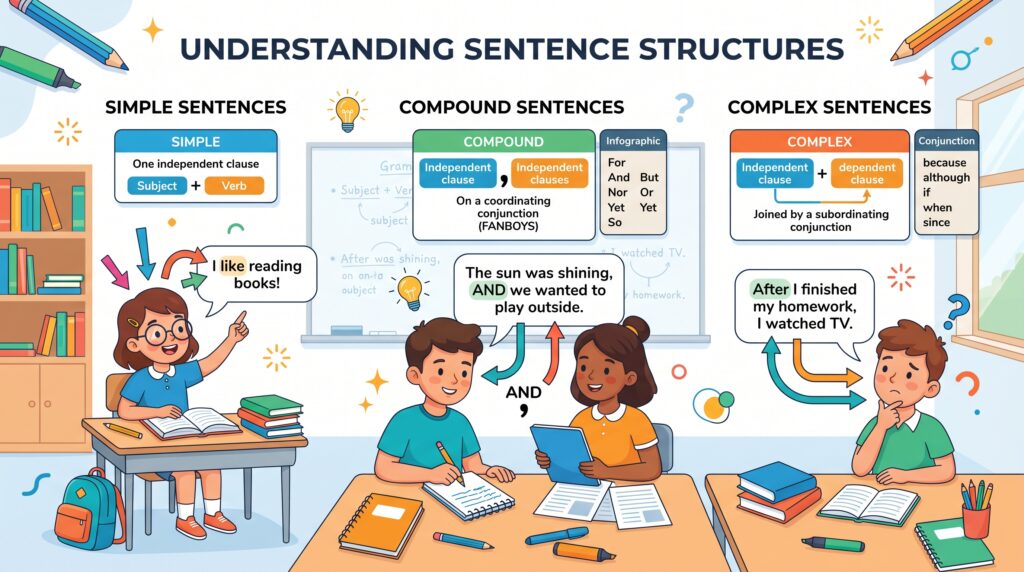
The three main sentence types are:
- Simple Sentences
- Compound Sentences
- Complex Sentences
What Is a Simple Sentence?
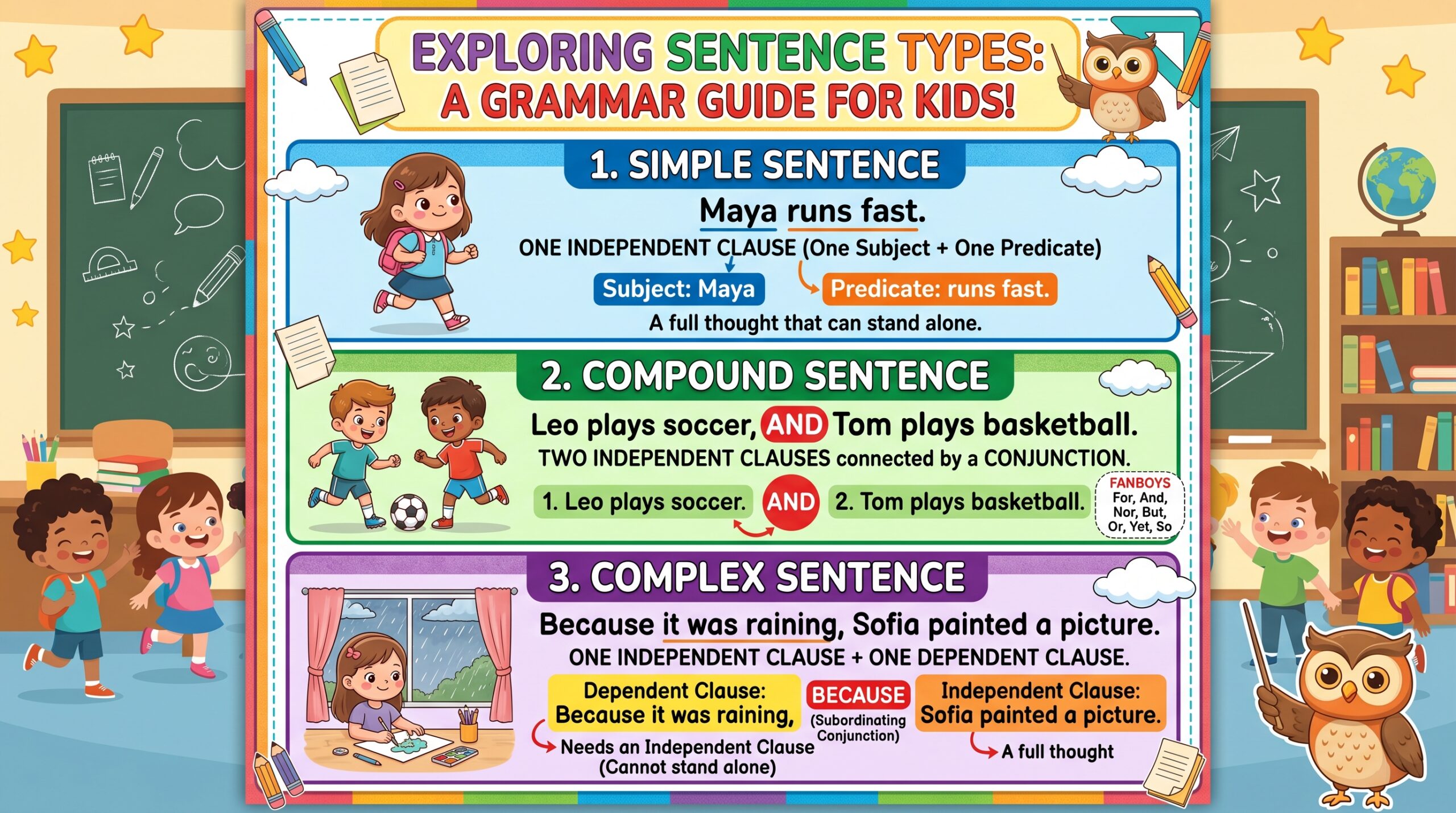
A simple sentence contains one independent clause. It expresses one complete idea.
Structure of a Simple Sentence
Subject + Verb + Complete Thought
Examples of Simple Sentences
- The dog barked loudly.
- She reads every night.
- We enjoy playing football.
- My brother works in a hospital.
- The sun rises in the east.
A simple sentence may contain compound subjects or verbs, but it still has only one independent clause.
Example
- Tom and Jerry play basketball every weekend.
What Is a Compound Sentence?
A compound sentence joins two or more independent clauses using a coordinating conjunction.
Coordinating Conjunctions
Remember the word FANBOYS:
- For
- And
- Nor
- But
- Or
- Yet
- So
Structure of a Compound Sentence
Independent Clause + Comma + Coordinating Conjunction + Independent Clause
Examples of Compound Sentences
- I wanted to go outside, but it started raining.
- She studied hard, so she passed the exam.
- We can watch a movie, or we can play games.
- The baby was crying, yet nobody heard him.
- He cooked dinner, and she washed the dishes.
What Is a Complex Sentence?
A complex sentence contains one independent clause and at least one dependent clause.
Dependent clauses usually begin with subordinating conjunctions like:
- Because
- Although
- When
- If
- Since
- While
- After
- Before
Structure of a Complex Sentence
Dependent Clause First
Dependent Clause + Comma + Independent Clause
Example:
- Because it was raining, we stayed indoors.
Independent Clause First
Independent Clause + Dependent Clause
Example:
- We stayed indoors because it was raining.
Examples of Complex Sentences
- Although he was tired, he finished his homework.
- When the bell rang, the students left the classroom.
- I will call you after I arrive home.
- If you study hard, you will succeed.
- The book that I borrowed is very interesting.
Difference Between Simple, Compound, and Complex Sentences
| Sentence Type | Clauses | Example |
|---|---|---|
| Simple Sentence | One independent clause | She likes coffee. |
| Compound Sentence | Two independent clauses | She likes coffee, and he likes tea. |
| Complex Sentence | One independent + one dependent clause | Because she likes coffee, she drinks it daily. |
Rules for Using Sentence Types Correctly
Rules for Simple Sentences
- Must contain one complete thought.
- Needs a subject and a verb.
- Can include adjectives and adverbs.
Example
- The small boy runs quickly.
Rules for Compound Sentences
- Use a comma before the conjunction.
- Both clauses must be complete sentences.
Correct Example
- I was hungry, so I made a sandwich.
Incorrect Example
- I was hungry so I made a sandwich.
Rules for Complex Sentences
- Use a comma when the dependent clause comes first.
- No comma is usually needed when the independent clause comes first.
Examples
- Because she was sick, she stayed home.
- She stayed home because she was sick.
Why Sentence Variety Is Important
Using only one sentence type can make writing sound boring or robotic.
Sentence variety:
- Improves readability
- Makes writing more interesting
- Creates natural rhythm
- Enhances communication skills
Example Paragraph
I woke up early today. I made breakfast, and I packed my bag. Because I had an important meeting, I left home early.
This paragraph sounds more natural because it uses all three sentence types.
Common Mistakes with Sentence Types
1. Comma Splice
Incorrect
I love English, I practice every day.
Correct
I love English, and I practice every day.
2. Missing Comma in Compound Sentences
Incorrect
She ran fast but she missed the bus.
Correct
She ran fast, but she missed the bus.
3. Sentence Fragment
Incorrect
Because I was tired.
Correct
Because I was tired, I went to sleep early.
4. Missing Comma After Introductory Clause
Incorrect
When he arrives we will start dinner.
Correct
When he arrives, we will start dinner.
Practice Exercises
Fill in the Blanks
- I was hungry, ______ I ate a sandwich.
- ______ it started raining, we stayed inside.
- The children ______ in the park.
- She will call you ______ she arrives home.
- He studied hard, ______ he passed the test.
Answers
- so
- Because / When
- played
- when / after
- so
Quick Summary
Simple Sentence
One independent clause.
Example
Compound Sentence
Two independent clauses joined with a conjunction.
Example
- I enjoy music, and my brother likes sports.
Complex Sentence
One independent clause and one dependent clause.
Example
- Because I enjoy music, I practice guitar daily.
Conclusion
Learning the types of sentences in English is an important step toward becoming a better writer and speaker. Simple sentences provide clarity, compound sentences connect ideas, and complex sentences add detail and depth.
By practicing these sentence structures regularly, you will improve your grammar, writing flow, and overall communication skills. Try mixing all three sentence types in your daily writing to make your English sound more natural and engaging.
FAQs About Types of Sentences in English
What are the main types of sentences in English?
The three main types are simple, compound, and complex sentences.
What is the difference between compound and complex sentences?
A compound sentence joins two complete ideas, while a complex sentence combines one complete idea with a dependent clause.
Can a simple sentence have two verbs?
Yes. A simple sentence can have compound verbs as long as it contains only one independent clause.
Example
- She sings and dances beautifully.
Why are complex sentences important?
Complex sentences help explain reasons, conditions, time, and relationships between ideas more clearly.
How can I improve sentence structure in English?
Practice writing different sentence types daily, read English books, and combine short ideas into longer sentences.