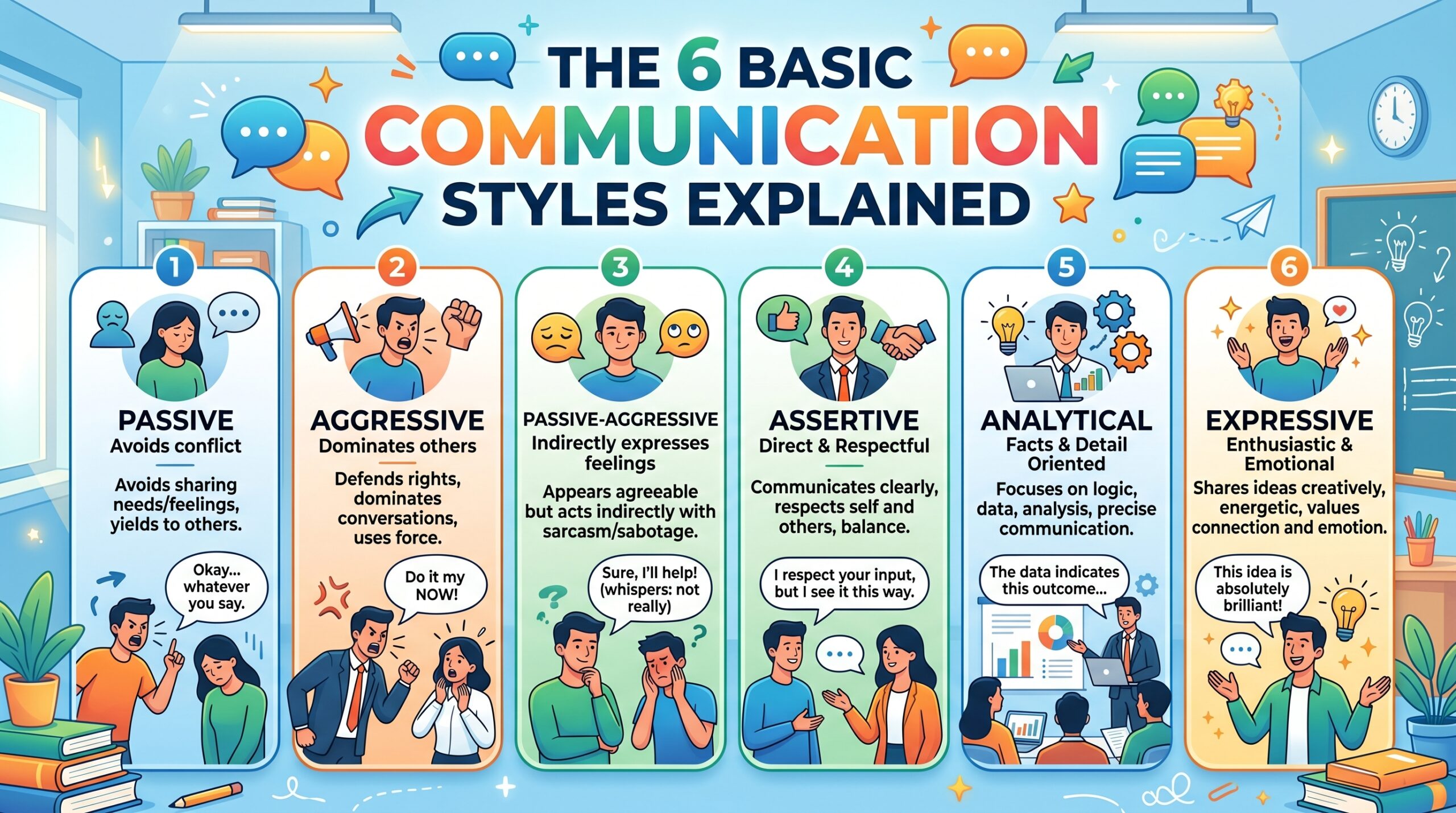
Communication is part of everything we do. Whether we are speaking with family, friends, coworkers, teachers, or customers, the way we communicate affects our relationships and success. People do not all communicate in the same way. Some speak directly, some avoid conflict, while others express themselves confidently and respectfully.
Understanding the 6 basic communication styles helps you recognize your own habits and improve your interactions with others. In this guide, you will learn the six communication styles, their characteristics, examples, and ways to communicate more effectively.
What Are Communication Styles?
Communication styles are the ways people express thoughts, feelings, opinions, and needs when interacting with others.
Your communication style affects:
- Personal relationships
- Workplace interactions
- Problem-solving
- Teamwork
- Leadership skills
- Daily conversations
Different situations may require different communication approaches.
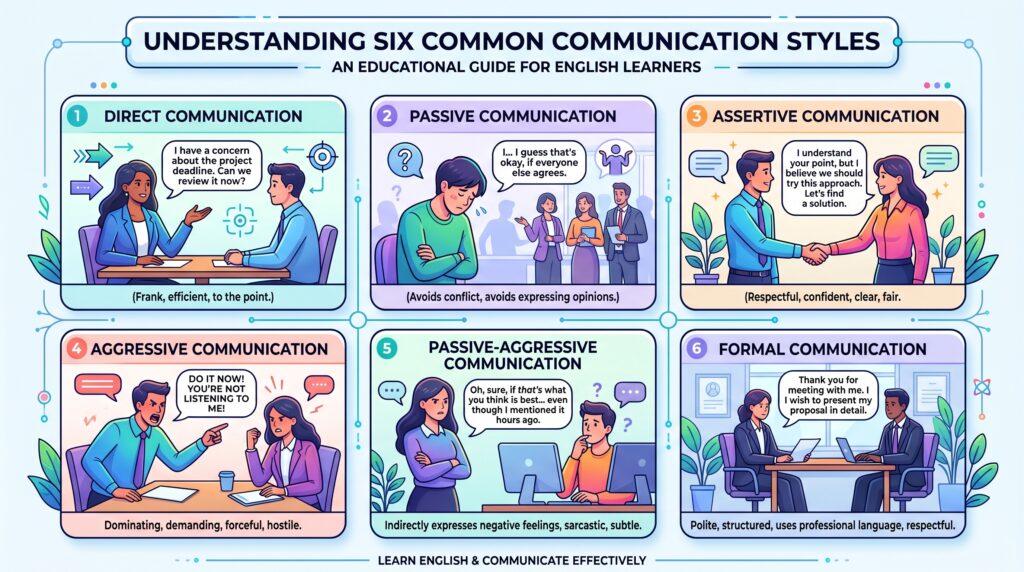
The 6 Basic Communication Styles
1. Direct Communication
Direct communication focuses on expressing ideas clearly and honestly without confusion.
Characteristics:
- Clear expression
- No beating around the bush
- Honest and transparent
- Respectful assertiveness
- Open and straightforward dialogue
Examples:
- “I need this report by Friday.”
- “I disagree with your idea because I see another solution.”
- “Please let me know if you need help.”
Advantages:
✔ Reduces misunderstandings
✔ Saves time
✔ Builds trust
Disadvantages:
✔ May appear too blunt if not expressed politely
2. Passive-Aggressive Communication
Passive-aggressive communication happens when people avoid direct expression but show negative feelings indirectly.
Characteristics:
- Sarcastic remarks
- Hidden insults
- Silent treatment
- Backhanded compliments
- Avoiding responsibility
Examples:
- “Nice job arriving on time… for once.”
- “It’s okay. I’ll just do everything myself.”
Advantages:
There are usually few long-term advantages because problems remain unresolved.
Disadvantages:
✘ Creates confusion
✘ Damages relationships
✘ Builds resentment
3. Assertive Communication
Assertive communication is often considered the healthiest communication style because it balances honesty with respect.
Characteristics:
- Clear and direct expression
- Respectful behavior
- Confident body language
- Calm expression of needs
- Active listening
Examples:
- “I understand your opinion, but I have a different perspective.”
- “I would appreciate more time to complete this task.”
Advantages:
✔ Builds healthy relationships
✔ Encourages respect
✔ Improves confidence
Disadvantages:
✔ Requires practice and self-awareness
4. Aggressive Communication
Aggressive communication occurs when someone prioritizes their own needs while ignoring the feelings of others.
Characteristics:
- Frequent interruptions
- Loud voice
- Demanding tone
- Blaming others
- Controlling behavior
Examples:
- “Do it my way.”
- “You never do anything right.”
Advantages:
✔ May create quick decisions in urgent situations
Disadvantages:
✘ Creates fear and conflict
✘ Damages trust
✘ Hurts relationships
5. Passive Communication
Passive communication happens when people avoid expressing their needs or opinions.
Characteristics:
- Listening more than speaking
- Avoiding conflict
- Agreeing frequently
- Hesitant speaking
- Difficulty expressing opinions
Examples:
- “Anything is fine with me.”
- “It doesn’t matter.”
Advantages:
✔ Avoids unnecessary arguments
Disadvantages:
✘ Needs remain unexpressed
✘ Low self-confidence may develop
✘ Others may take advantage
6. Formal Communication
Formal communication follows structured rules and is commonly used in professional or official situations.
Characteristics:
- Polished language
- Respectful greetings
- Organized structure
- Appropriate vocabulary
- Professional tone
Examples:
- “Dear Mr. Johnson, I hope you are doing well.”
- “Please find the attached document.”
Advantages:
✔ Professional appearance
✔ Clear organization
✔ Suitable for business settings
Disadvantages:
✘ Can sound less personal
Comparison of Communication Styles
| Style | Main Focus | Common Behavior |
|---|---|---|
| Direct | Clarity | Honest and straightforward |
| Passive-Aggressive | Hidden feelings | Sarcasm and indirect behavior |
| Assertive | Balance and respect | Clear and confident |
| Aggressive | Control | Loud and demanding |
| Passive | Avoid conflict | Quiet and hesitant |
| Formal | Professionalism | Structured communication |
How to Improve Your Communication Style
Step 1: Practice active listening
Listen carefully before responding.
Step 2: Express needs clearly
Say what you think politely and directly.
Step 3: Control emotions
Avoid reacting with anger during disagreements.
Step 4: Watch body language
Maintain eye contact and use positive gestures.
Step 5: Be respectful
Respect different opinions even when you disagree.
Common Communication Mistakes
Mistake 1: Interrupting others
Cutting people off while speaking
Wait until the person finishes talking
Mistake 2: Using aggressive language
“You are always wrong.”
“I see the situation differently.”
Mistake 3: Avoiding communication completely
Staying silent when problems arise
Express concerns calmly
Mistake 4: Being unclear
“Maybe someday.”
“Let’s meet on Monday at 3 PM.”
Quick Summary
- Communication styles affect daily interactions.
- There are six basic communication styles.
- Assertive communication is usually considered the most balanced style.
- Passive-aggressive communication creates hidden conflict.
- Formal communication is useful in professional settings.
- Clear and respectful communication improves relationships.
Practice Exercises
Identify the communication style:
- “Please complete the report by tomorrow.”
- “Fine, do whatever you want.”
- “I understand your opinion, but I disagree.”
- “You never listen to anyone.”
- “Dear Sir, I am writing regarding your request.”
Answers
- Direct communication
- Passive-aggressive communication
- Assertive communication
- Aggressive communication
- Formal communication
Conclusion
Understanding the 6 basic communication styles helps you become a better speaker, listener, and communicator. Different situations require different approaches, but assertive communication often creates the healthiest and most effective relationships.
By practicing clear expression, active listening, and respectful dialogue, you can improve your communication skills in both personal and professional life.
FAQ
1. What are the six communication styles?
The six communication styles are:
- Direct communication
- Passive-aggressive communication
- Assertive communication
- Aggressive communication
- Passive communication
- Formal communication
2. Which communication style is best?
Assertive communication is generally considered the most effective because it balances confidence with respect.
3. Can communication styles change?
Yes. Communication styles can improve with practice and self-awareness.
4. Why is communication important?
Communication helps people express thoughts, solve problems, build relationships, and share information.
5. How can I become a better communicator?
Practice listening carefully, speak clearly, respect others, and express your ideas confidently.