Have you ever wondered whether to say at 7 PM, on Monday, or in July? Many English learners find these small words confusing because they all refer to time. However, once you understand the simple rules, choosing the correct preposition becomes easy.
In this guide, you’ll learn how to use at, on, and in, along with examples, common mistakes, and practice exercises.
What Are Prepositions of Time?
Prepositions of time are words that show when an action happens. They connect people, events, or activities to a specific time.
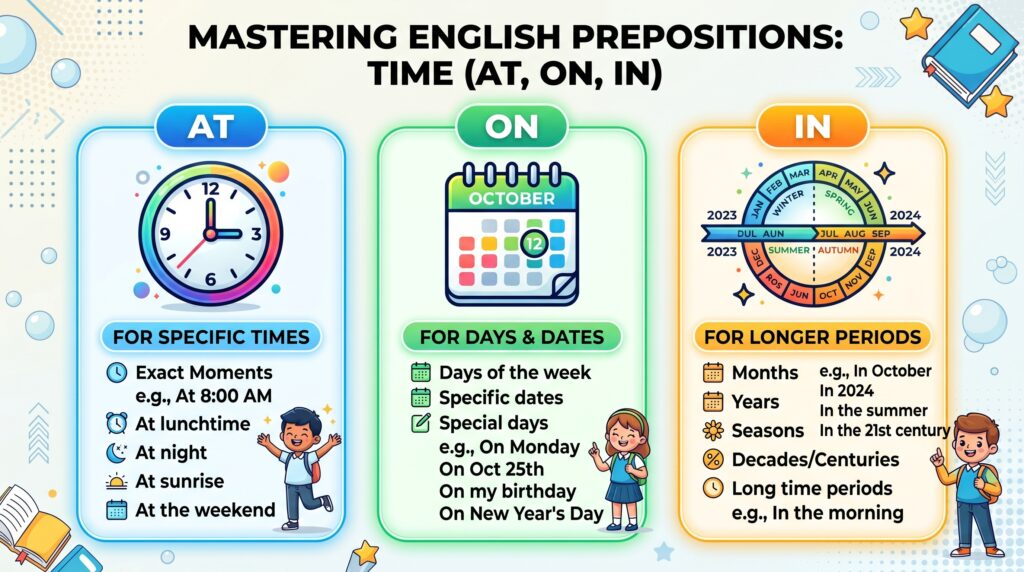
The three most common prepositions of time are:
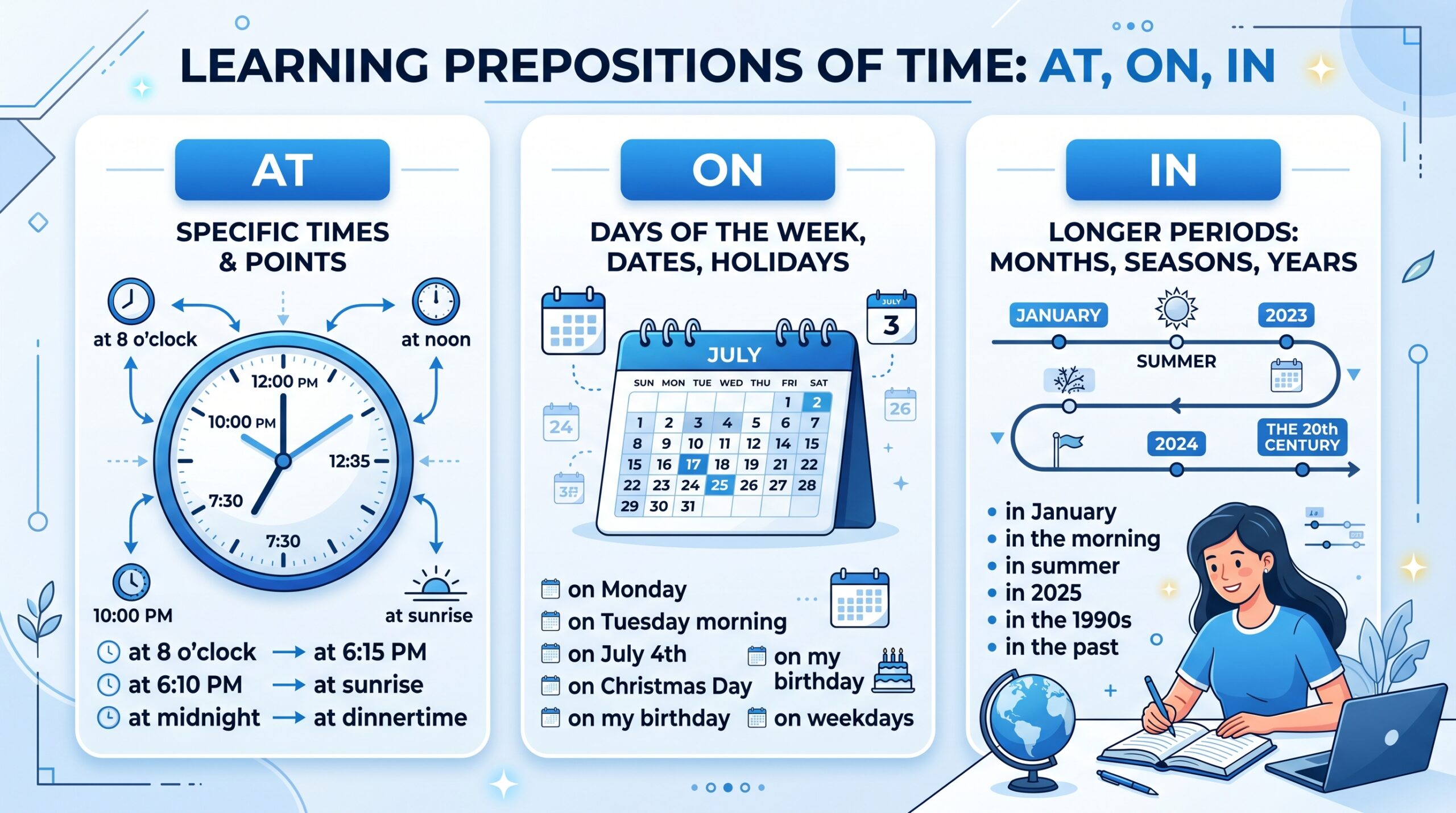
- At → Specific times
- On → Days and dates
- In → Longer periods of time
These words help us place events correctly on a timeline.
How to Use “At”
We use at for precise or exact points in time.
Use “At” For:
- Clock times
- Midnight
- Noon
- Sunrise and sunset
- Night
- Special moments
Examples:
- My class starts at 8:00 AM.
- Let’s meet at noon.
- The shop closes at midnight.
- I usually study at night.
- We arrived at sunrise.
Common Time Expressions with At
- At night
- At present
- At the moment
- At lunchtime
- At Christmas (holiday period)
How to Use “On”
We use on for specific days and dates.
Use “On” For:
- Days of the week
- Dates
- Special days
- Specific mornings, afternoons, or evenings
Examples:
- I have a meeting on Monday.
- She was born on July 15th.
- We visited them on Christmas Day.
- The exam is on Friday morning.
- They got married on Valentine’s Day.
How to Use “In”
We use in for longer periods of time.
Use “In” For:
- Months
- Years
- Seasons
- Centuries
- Parts of the day
Examples:
- My birthday is in March.
- She graduated in 2023.
- Flowers bloom in spring.
- They lived there in the 18th century.
- I exercise in the morning.
Common Expressions with In
- In the morning
- In the afternoon
- In the evening
- In the future
- In a few minutes
Quick Comparison Table
| Preposition | Used For | Example |
|---|---|---|
| At | Exact times | At 7 PM |
| On | Days and dates | On Monday |
| In | Months, years, seasons | In June |
| At | Night | At night |
| In | Parts of the day | In the morning |
| On | Specific mornings | On Monday morning |
Special Exceptions to Remember
English has a few fixed expressions that don’t follow the general pattern.
Use At
- At night
- At noon
- At midnight
- At present
- At the weekend (British English)
Use On
- On Monday morning
- On Friday afternoon
- On Christmas Day
- On New Year’s Day
Use In
- In the morning
- In the afternoon
- In the evening
Examples of Prepositions of Time in Sentences
Here are some real-life examples:
- The meeting starts at 10 AM.
- We are traveling in December.
- She works on Saturdays.
- I usually read at night.
- They moved here in 2022.
- My birthday falls on August 20th.
- We have English class on Tuesday morning.
- The project will finish in two weeks.
- Let’s meet at lunchtime.
- The flowers bloom in spring.
Common Mistakes and Corrections
Mistake 1
I will call you in 6 PM.
I will call you at 6 PM.
Mistake 2
The meeting is at Monday.
The meeting is on Monday.
Mistake 3
She graduated on 2020.
She graduated in 2020.
Mistake 4
I exercise on the morning.
I exercise in the morning.
Mistake 5
We met in Friday.
We met on Friday.
Practice Exercises
Choose the correct preposition: at, on, or in.
Exercise 1
I usually wake up ___ 6:30 AM.
Exercise 2
My birthday is ___ May.
Exercise 3
We play football ___ Saturdays.
Exercise 4
She was born ___ 2010.
Exercise 5
I like reading ___ night.
Answers
- at
- in
- on
- in
- at
FAQs About Prepositions of Time
Do we say “on the weekend” or “at the weekend”?
- American English: On the weekend
- British English: At the weekend
Both are correct depending on the variety of English.
Why do we say “at night” but “in the morning”?
This is a fixed English expression. While morning, afternoon, and evening are considered longer periods, night is treated as a specific time period.
- In the morning
- In the afternoon
- In the evening
- At night
Do we use prepositions with last, next, every, and this?
No.
Correct:
- Last week
- Next month
- Every day
- This evening
Incorrect:
- On last week
- In next month
What’s the difference between “on time” and “in time”?
On Time
Means punctual.
Example:
- The train arrived on time.
In Time
Means early enough.
Example:
- We arrived in time for the movie.
Conclusion
Learning prepositions of time is essential for speaking and writing English naturally. Remember the simple rule:
At = exact times
On = days and dates
In = months, years, seasons, and longer periods