Phrasal verbs are an essential part of everyday English. If you want to speak naturally, understand conversations, and improve fluency, learning phrasal verbs is a must.
In this guide, you’ll discover 20 commonly used phrasal verbs, simple meanings, easy examples, and helpful tips to avoid mistakes.
What Are Phrasal Verbs?
A phrasal verb is made by combining:
👉 Verb + preposition or adverb
Together, they create a new meaning that is often different from the original verb.
Example:
- Give up → means to stop trying
- Look after → means to take care of
👉 Learning them helps you sound more like a native speaker.
Types of Phrasal Verbs
1. Separable Phrasal Verbs
You can place the object between the verb and particle
- Turn off the light
- Turn the light off
- Turn it off ✅
2. Inseparable Phrasal Verbs
The object must come after the full phrasal verb
- Look after the baby ✅
- ❌ Look the baby after
3. Transitive vs Intransitive
- Transitive → needs an object
- Intransitive → no object needed
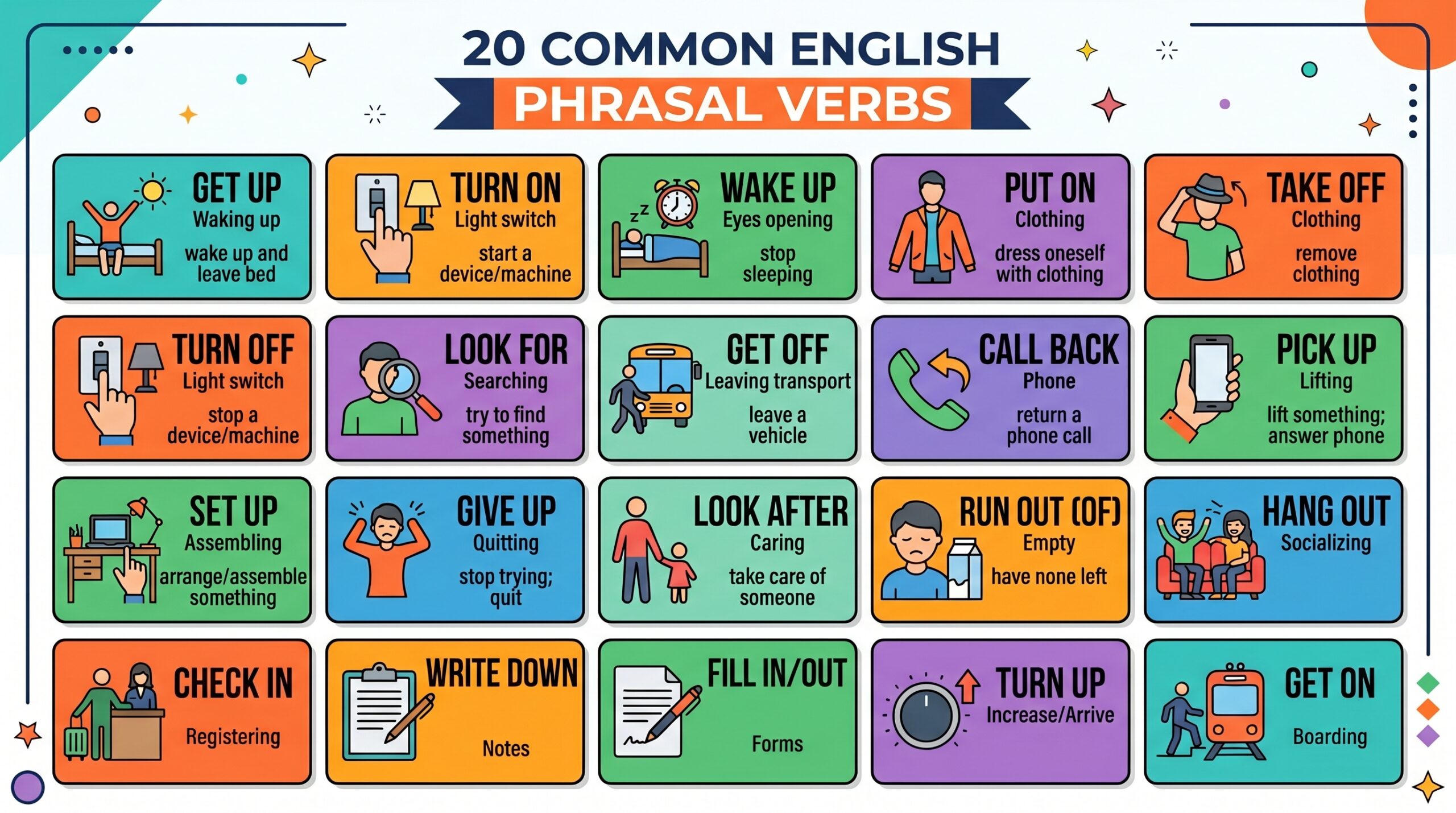
20 Most Common Phrasal Verbs (With Examples)
Daily Use Phrasal Verbs
- Get up – leave bed
👉 I get up early every day. - Wake up – stop sleeping
👉 She wakes up at 6 a.m. - Turn on – start something
👉 Turn on the fan. - Turn off – stop something
👉 Turn off the lights. - Pick up – collect or lift
👉 I will pick up my friend. - Put on – wear
👉 He put on his shoes. - Take off – remove / plane leaves
👉 She took off her jacket. - Look for – search
👉 I am looking for my keys. - Look after – take care of
👉 She looks after her sister. - Give up – quit
👉 Don’t give up easily.
More Useful Phrasal Verbs
- Come back – return
👉 He will come back soon. - Go out – leave home
👉 Let’s go out tonight. - Find out – discover
👉 I want to find out the truth. - Run out of – have no more
👉 We ran out of sugar. - Break down – stop working
👉 My car broke down. - Get along with – have a good relationship
👉 I get along with my classmates. - Call back – return a call
👉 I will call you back later. - Put away – keep/store
👉 Put away your toys. - Show up – arrive
👉 He didn’t show up. - Work out – exercise / solve
👉 I work out daily.
👉 We need to work out a plan.
Common Mistakes to Avoid
Wrong:
I will pick up it
Correct:
I will pick it up
Wrong:
She looks after for him
Correct:
She looks after him
Wrong:
We ran out of
Correct:
We ran out of milk
Wrong:
Call back me
Correct:
Call me back
Easy Tips to Learn Phrasal Verbs
- Learn 5–10 verbs weekly
- Use them in daily sentences
- Watch English videos
- Practice speaking regularly
- Focus on meaning, not translation
Practice Exercise
Fill in the blanks:
- I ________ at 7 a.m.
- Please ________ the lights.
- I will ________ you later.
- We have ________ milk.
- She ________ her little brother.
Answers:
- get up
- turn off
- call back
- run out of
- looks after
Conclusion
Learning these 20 common phrasal verbs will improve your English speaking and understanding. Practice regularly, use them in daily conversation, and soon they will become natural for you.
FAQs About Phrasal Verbs
1. What is a phrasal verb?
A combination of a verb and a particle that creates a new meaning.
2. Are phrasal verbs important?
Yes, they are very common in spoken English.
3. Can I use phrasal verbs in writing?
Yes, but mostly in informal writing.
4. How can I learn them fast?
Practice daily and use them in real sentences.