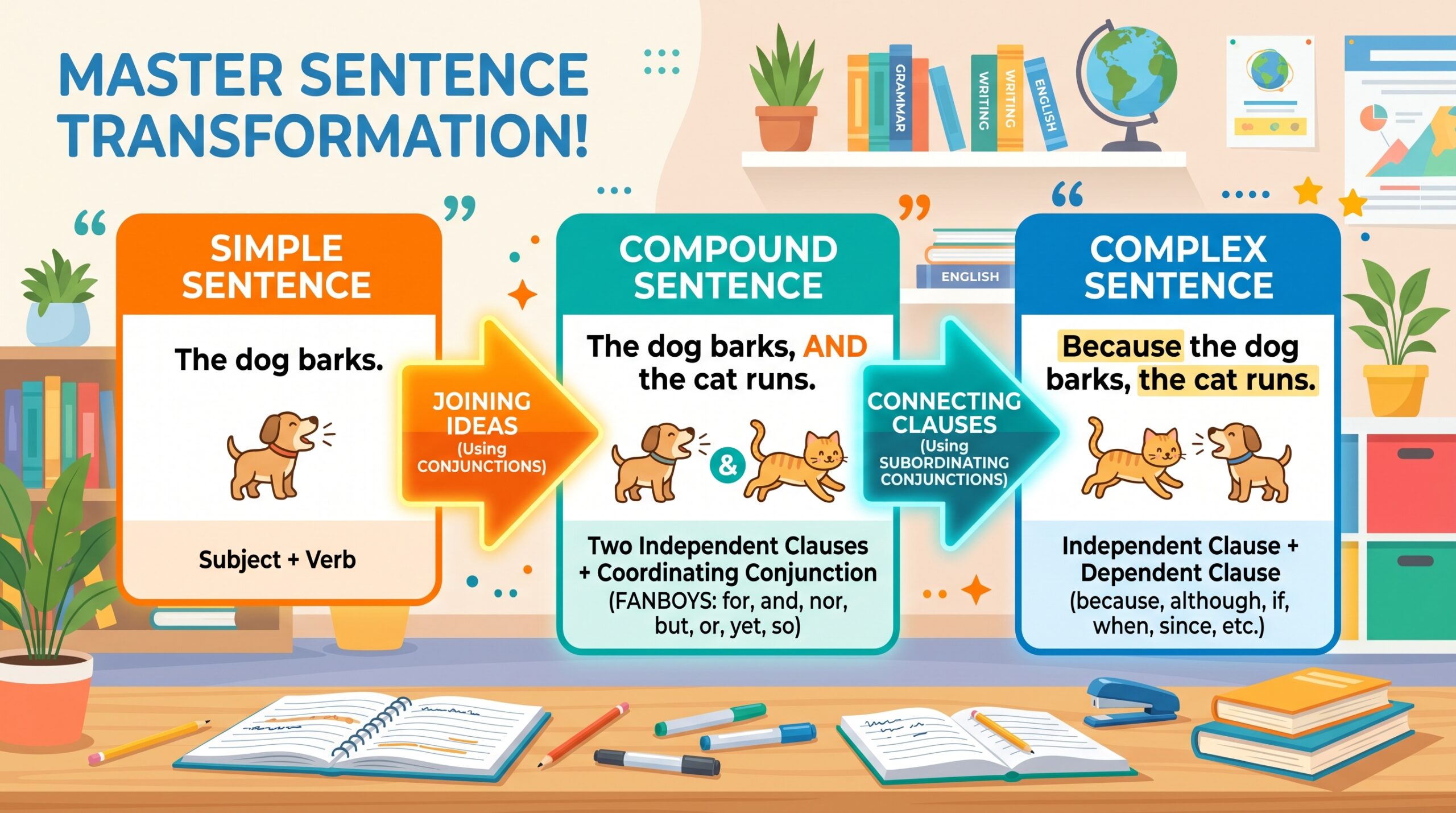
Have you ever wanted to express the same idea in different ways without changing its meaning? That is where transformation of sentences becomes useful. Sentence transformation means changing the structure or form of a sentence while keeping the original meaning unchanged.
Learning sentence transformation improves your writing style, helps avoid repetition, and makes your communication more effective. Whether you are preparing for exams, improving your English grammar, or learning better writing skills, understanding sentence transformation is essential.
In this guide, you will learn sentence types, transformation rules, examples, common mistakes, and practice exercises.
What Is Transformation of Sentences?
Transformation of sentences is the process of changing a sentence from one form into another while keeping its meaning the same.
For example:
Simple: She works hard.
Compound: She works hard, and she achieves success.
Complex: Because she works hard, she achieves success.
Although the structure changes, the main idea remains the same.
Types of Sentences
There are three major sentence types used in transformation:
1. Simple Sentence
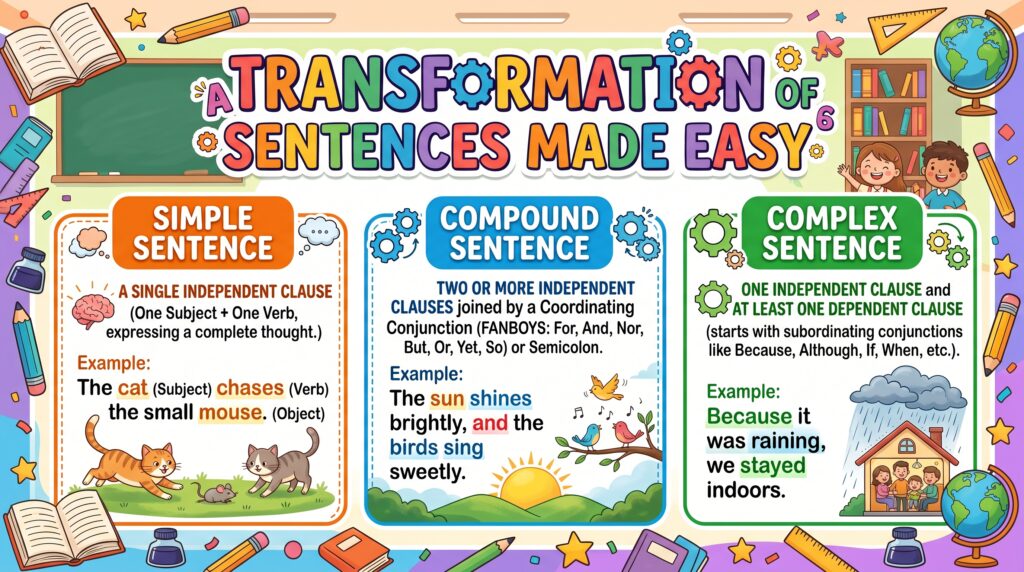
A simple sentence contains one independent clause and expresses a complete thought.
Structure:
Subject + Verb
Subject + Verb + Object
Subject + Verb + Complement
Subject + Verb + Adverbial
Examples:
- The cat sleeps.
- She reads books.
- They play football in the park.
- He is a teacher.
2. Compound Sentence
A compound sentence contains two or more independent clauses joined by coordinating conjunctions:
For, And, Nor, But, Or, Yet, So (FANBOYS)
Structure:
Independent Clause + Conjunction + Independent Clause
Examples:
- I wanted to go outside, but it started raining.
- She enjoys reading, and he likes writing.
- The weather is sunny, yet it feels cold.
- He practices daily, so he improves quickly.
3. Complex Sentence
A complex sentence contains one independent clause and at least one dependent clause.
Dependent clauses often begin with:
- because
- although
- since
- when
- while
- if
- after
- before
Structure:
Independent Clause + Dependent Clause
OR
Dependent Clause + Independent Clause
Examples:
- Although it was raining, we went outside.
- She reads books because she loves stories.
- When he arrives, we will begin.
- The dog barked while the cat slept.
Rules for Transformation of Sentences
Rule 1: Keep the Meaning the Same
The sentence structure may change, but the original meaning should remain unchanged.
She studies hard → She studies lazily
She studies hard → Because she studies hard, she succeeds.
Rule 2: Use Appropriate Conjunctions
Compound sentences use coordinating conjunctions:
- and
- but
- so
- yet
- or
Complex sentences use subordinating conjunctions:
- because
- although
- when
- if
- while
Rule 3: Identify Independent and Dependent Clauses
Before transforming a sentence, determine whether clauses can stand alone.
Example:
Independent clause:
“I finished my homework.”
Dependent clause:
“because I had free time.”
Rule 4: Avoid Sentence Fragments
Dependent clauses cannot stand alone.
Because I was tired.
Because I was tired, I went to bed.
Transformation Examples
| Simple Sentence | Compound Sentence | Complex Sentence |
|---|---|---|
| She runs. | She runs, and he walks. | She runs because she enjoys exercise. |
| He plays football. | He plays football, but he likes basketball too. | He plays football although he feels tired. |
| She is happy. | She is happy, yet she wants more. | Although she is happy, she wants more. |
| They swim quickly. | They swim quickly, and they dive deep. | They swim quickly because they are practicing. |
| He reads books at night. | He reads books, but he does not watch TV. | He reads books when he has free time. |
| She writes letters. | She writes letters, and he posts them. | She writes letters although she is busy. |
| The cat sleeps on the mat. | The cat sleeps, but the dog barks. | The cat sleeps while the dog plays. |
| The soup tastes delicious. | The soup tastes good, yet it is very hot. | The soup tastes delicious when served warm. |
How to Transform Sentences
Step 1: Identify the sentence type
Determine whether the sentence is simple, compound, or complex.
Example:
“She studies daily.” → Simple
Step 2: Find the main idea
Understand what message the sentence expresses.
Step 3: Add clauses carefully
To convert:
Simple → Compound
Add another independent clause.
Example:
She studies daily.
→ She studies daily, and she performs well.
Step 4: Convert into complex form
Add a dependent clause.
Example:
She studies daily.
→ Because she studies daily, she performs well.
Common Mistakes
Mistake 1: Changing the meaning
She is tired → She is energetic
She is tired → Because she is tired, she wants to rest.
Mistake 2: Incorrect conjunction use
I studied because I passed the exam.
I studied hard, so I passed the exam.
Mistake 3: Creating fragments
Although he was sick.
Although he was sick, he attended class.
Mistake 4: Missing punctuation
Although it was raining we stayed home.
Although it was raining, we stayed home.
Quick Summary
- Sentence transformation changes structure without changing meaning.
- Simple sentences contain one independent clause.
- Compound sentences contain two or more independent clauses.
- Complex sentences contain one independent clause and one dependent clause.
- Use conjunctions correctly.
- Avoid sentence fragments.
Practice Exercises
Transform the following into the required sentence type.
- She sings beautifully. (Compound)
- He worked hard. (Complex)
- They walked to school. (Compound)
- I finished my work. (Complex)
- The baby cried loudly. (Compound)
Answers
- She sings beautifully, and everyone enjoys listening.
- Because he worked hard, he achieved success.
- They walked to school, and they reached early.
- Because I finished my work, I relaxed.
- The baby cried loudly, and the mother picked him up.
Conclusion
Transformation of sentences is an important grammar skill that helps make writing more varied and effective. By learning how simple, compound, and complex sentences work, you can express ideas in multiple ways without changing meaning.
Practice transforming sentences regularly, and soon it will become a natural part of your English writing and speaking.
FAQ
1. What is sentence transformation in English grammar?
Sentence transformation means changing the structure of a sentence while keeping the original meaning unchanged.
2. Why is sentence transformation important?
It improves writing style, avoids repetition, and increases grammatical accuracy.
3. What are the three main sentence types?
The three main types are:
- Simple sentence
- Compound sentence
- Complex sentence
4. Can sentence transformation change meaning?
No. The meaning should remain the same even though the structure changes.
5. How can I improve sentence transformation skills?
Practice identifying clauses, learn conjunctions, and regularly rewrite sentences in different forms.