Affirmative sentences are the foundation of clear and confident communication in English. Whether you are speaking, writing, or learning grammar, using affirmative sentences correctly helps you express ideas in a simple and positive way.
In this guide, you’ll learn what affirmative sentences are, their types, and a list of 66 easy examples to improve your English skills.
What is an Affirmative Sentence?
An affirmative sentence is a sentence that states something positively. It tells us that something is true, happening, or has happened.
Examples:
- She likes reading books.
- The sun rises in the east.
👉 These sentences give clear information without negation or questions.
Key Features of Affirmative Sentences
- Start with a subject
- Follow a subject + verb (+ object) structure
- Express a positive statement
- Do not include “not” or question forms
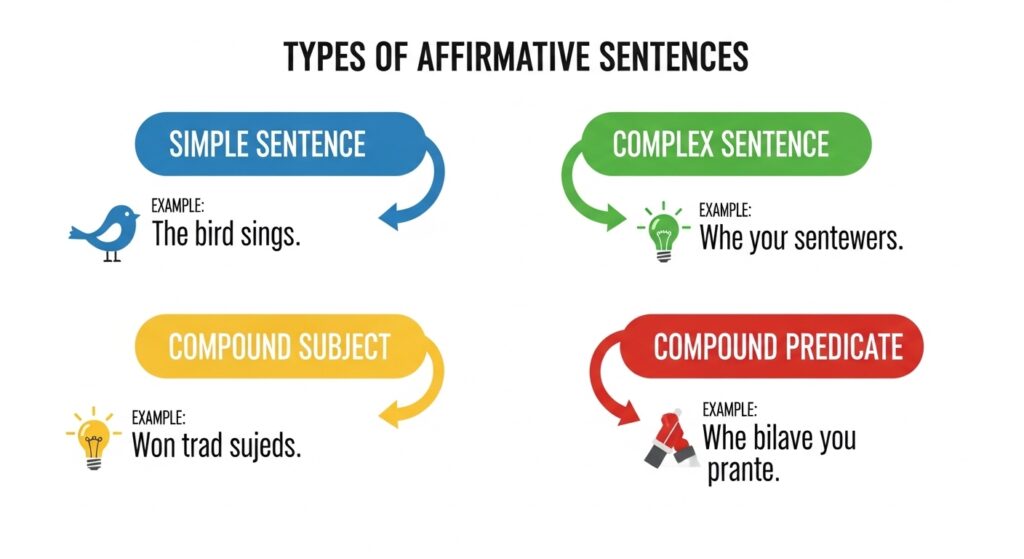
Types of Affirmative Sentences
1. Simple Affirmative Sentences
Basic and direct statements.
Example: She plays football.
2. Complex Affirmative Sentences
Contain more than one idea joined by connectors.
Example: He works hard because he wants success.
3. Compound Subject Sentences
More than one subject.
Example: Ali and Ahmed are friends.
4. Compound Predicate Sentences
More than one action.
Example: She sings and dances.
5. Affirmative Sentences with Objects
Include subject, verb, and object.
Example: I wrote a letter.
66 Affirmative Sentences List
Here are 66 simple affirmative sentences for practice:
- She reads books every day.
- They visited the park yesterday.
- The sun rises in the east.
- I completed my homework on time.
- We will join the meeting tomorrow.
- My brother plays cricket well.
- The weather is very pleasant today.
- He speaks English fluently.
- They won the match last week.
- I woke up early this morning.
- She drinks tea every morning.
- The dog is sleeping quietly.
- I go to school daily.
- The company launched a new product.
- We watched a movie last night.
- The children are playing in the garden.
- Our team scored a goal.
- He bought a new phone.
- I love my family.
- She is preparing for exams.
- We are planning a trip soon.
- The shop sells fresh fruits.
- I met him yesterday.
- The flowers are blooming beautifully.
- He arrives on time every day.
- She cooks delicious food.
- The kids are happy today.
- We visited the zoo last month.
- I made lunch for everyone.
- They are working on a project.
- I prefer coffee in the morning.
- She runs in the park daily.
- We rented a house for vacation.
- The store opens at 9 a.m.
- I received a gift yesterday.
- He plays the guitar.
- They are learning English.
- The park looks beautiful.
- I walk every evening.
- My sister is an artist.
- We celebrated the festival happily.
- She is going on a trip next week.
- The bus arrives at 8 a.m.
- They organize events every year.
- I met a new teacher.
- She designs creative dresses.
- We enjoyed dinner together.
- I feel better after exercise.
- He plays football on weekends.
- The children are learning new skills.
- She is writing a story.
- We received great service.
- I finished reading the book.
- The show was amazing.
- They planted trees in the park.
- I enjoy going to the beach.
- She takes care of her pets.
- He is learning photography.
- We had fun at the party.
- The school arranged a trip.
- I go for a walk daily.
- They are hosting a party.
- I eat breakfast every day.
- He watches movies at night.
- We visited our relatives.
- She sings beautifully.
Common Mistakes to Avoid
- ❌ Adding “not” (makes it negative)
- ❌ Turning it into a question
- ❌ Incorrect sentence structure
- ❌ Missing subject or verb
Tips to Learn Faster
- Practice speaking daily
- Write 5–10 sentences every day
- Read simple English texts
- Focus on subject + verb structure
Conclusion
Affirmative sentences are simple but powerful tools for communication. By practicing these 66 examples, you can improve your grammar, speaking, and writing skills quickly.
Keep practicing daily, and you’ll become more confident in English!
FAQs About Affirmative Sentences
1. What is an affirmative sentence?
It is a sentence that expresses a positive statement or fact.
2. What is the structure of an affirmative sentence?
Subject + verb + object.
3. Can affirmative sentences be in past or future?
Yes, they can be in any tense.
4. Why are affirmative sentences important?
They help communicate ideas clearly and confidently.