Words that sound exactly the same but have different meanings can sometimes create confusion in English. Have you ever wondered whether to write their or there, or perhaps to, too, or two? These words belong to an interesting group called homophones.
Learning homophones is important because they improve your writing, speaking, reading, and communication skills. Understanding these words can help you avoid common grammar mistakes and make your English more accurate.
In this article, you’ll learn what homophones are, their types, rules, common examples, and a list of 100+ homophones examples with meanings and sentence usage.
What Are Homophones?
A homophone is a word that sounds the same as another word but differs in spelling, meaning, or both.
Examples:
- Two → Number 2
- Too → Also or excessively
- To → Shows direction or purpose
Sentence examples:
- I have two cats.
- I want to come too.
- We are going to school.
Types of Homophones in English
English contains several categories of similar-sounding words.
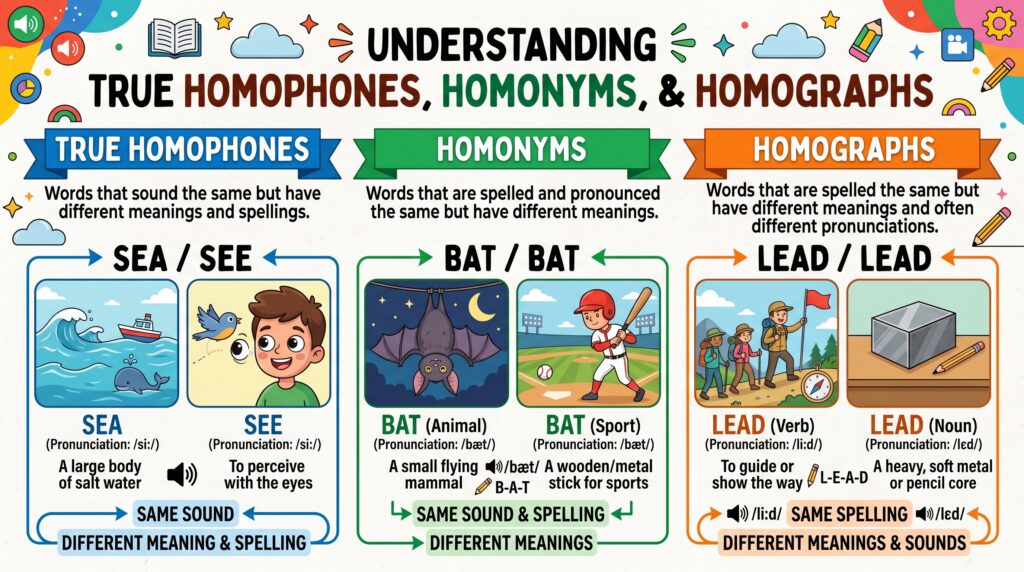
1. True Homophones
These words have the same pronunciation but different spellings and meanings.
Examples:
- Sea — See
- Brake — Break
- Right — Write
Sentence:
- I can see the beautiful sea.
2. Homonyms
Homonyms are words with identical spelling and pronunciation but different meanings.
Examples:
- Bat (animal)
- Bat (sports equipment)
Sentence:
- The bat flew into the cave.
- He hit the ball with a bat.
3. Homographs
Homographs are words with the same spelling but different meanings and sometimes different pronunciation.
Examples:
- Lead (to guide)
- Lead (metal)
Sentence:
- She will lead the team.
- The pipe is made of lead.
Rules for Using Homophones Correctly
Understanding homophones becomes easier when you follow some simple rules:
Pay attention to context
The meaning of the sentence usually tells you which word is correct.
Example:
- Their house is beautiful.
- Please put the bag over there.
Learn commonly confused pairs
Focus on frequently confused words:
- Your / You’re
- Their / There
- To / Too / Two
Proofread your writing
Spell-check tools may not catch homophone mistakes because both words are technically correct spellings.
Practice regularly
Use homophones in daily conversations and writing exercises.
Commonly Confused Homophones Examples
There vs Their vs They’re
There → indicates a place
Example:
- The books are over there.
Their → indicates possession
Example:
- That is their car.
They’re → contraction of “they are”
Example:
- They’re coming today.
To vs Too vs Two
To → direction or purpose
Example:
- I am going to school.
Too → also or excessively
Example:
- I want ice cream too.
Two → number
Example:
- I have two brothers.
Right vs Write
Right → correct or opposite of left
Example:
- Your answer is right.
Write → form words on paper
Example:
- Please write your name.
100+ Common Homophones Examples List
| Homophone Pair | Meaning |
|---|---|
| Air — Heir | Atmosphere / Successor |
| Bare — Bear | Without covering / Animal |
| Brake — Break | Stop / Separate |
| Cell — Sell | Small room / Trade |
| Deer — Dear | Animal / Loved person |
| Fair — Fare | Just / Ticket price |
| Flour — Flower | Baking ingredient / Plant |
| Hour — Our | Time unit / Possession |
| Know — No | Understand / Negative |
| Mail — Male | Letters / Gender |
| Meet — Meat | Encounter / Food |
| Pair — Pear | Two items / Fruit |
| Peace — Piece | Harmony / Portion |
| Plain — Plane | Simple / Aircraft |
| Principal — Principle | School head / Rule |
| Right — Write | Correct / Put words |
| Road — Rode | Path / Past of ride |
| Role — Roll | Character / Rotate |
| Sight — Site | Vision / Location |
| Son — Sun | Child / Star |
| Tail — Tale | Animal part / Story |
| Weak — Week | Not strong / Seven days |
| Weather — Whether | Climate / Choice |
| Whole — Hole | Complete / Opening |
| Buy — By | Purchase / Near |
| Allowed — Aloud | Permitted / Spoken loudly |
| Sail — Sale | Travel on water / Discount |
| Some — Sum | Quantity / Total |
| Steel — Steal | Metal / Take illegally |
| Waist — Waste | Body part / Unused material |
Practice Exercise
Choose the correct homophone:
- I want ___ apples. (to/too/two)
- Please ___ your answer. (write/right)
- We walked near the ___. (sea/see)
- Is this ___ house? (their/there)
- Can you ___ me? (hear/here)
Answers:
- Two
- Write
- Sea
- Their
- Hear
Conclusion
Homophones can be confusing at first, but regular practice makes them easier to understand. Learning these homophones examples helps improve grammar, spelling, and communication skills. Focus on context, practice commonly confused words, and use them in sentences regularly.
Frequently Asked Questions
What is a homophone?
A homophone is a word that sounds the same as another word but has a different meaning and often a different spelling.
Example:
- Write / Right
Why are homophones important?
Homophones help improve:
- Writing accuracy
- Reading comprehension
- Vocabulary skills
- Communication abilities
What are common homophone examples?
Some common examples include:
- Their / There
- To / Too / Two
- Sea / See
- Peace / Piece
- Know / No