Understanding direct and indirect speech is an important part of English grammar. It helps you report what someone said clearly and correctly in both speaking and writing.
In this guide, you’ll learn definitions, rules, examples, and easy conversion steps to master this topic.
What is Direct Speech?
Direct speech shows the exact words spoken by a person. It is always written inside quotation marks (“ ”).
Examples of Direct Speech
- “I am feeling tired,” he said.
- She said, “I will call you later.”
👉 In these sentences, the speaker’s exact words are used without any change.
What is Indirect Speech?
Indirect speech (also called reported speech) tells what someone said without using their exact words.
It does not use quotation marks and often changes tense and pronouns.
Examples of Indirect Speech
- He said that he was feeling tired.
- She said that she would call me later.
👉 Here, the message is the same, but the wording is slightly changed.
Difference Between Direct and Indirect Speech
| Direct Speech | Indirect Speech |
|---|---|
| Uses exact words | Reports the meaning |
| Uses quotation marks | No quotation marks |
| No tense change | Tense usually changes |
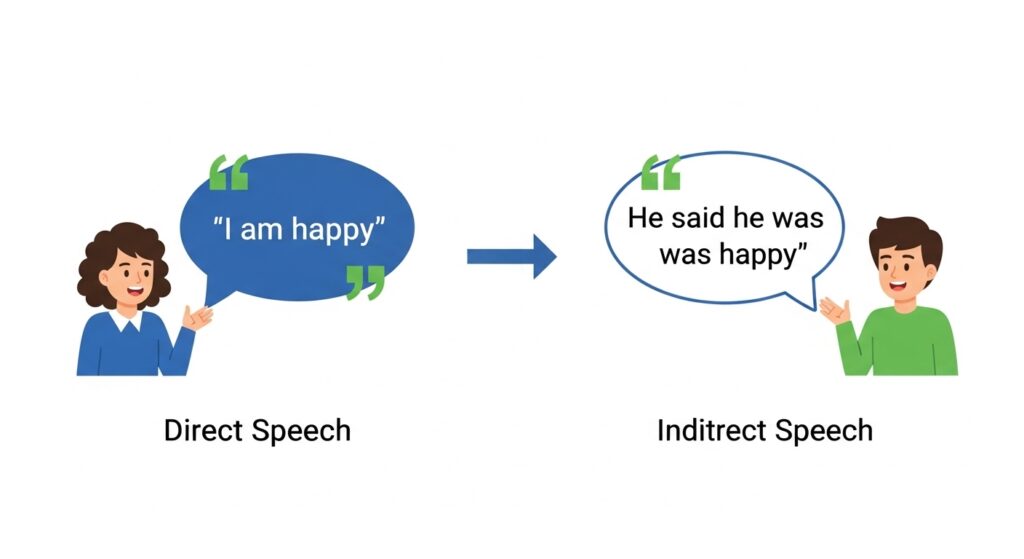
| Example: “I am happy” | He said he was happy |
Rules for Changing Direct to Indirect Speech
To convert sentences correctly, follow these simple rules:
1. Change the Tense (Backshift Rule)
Present Simple→Past Simple
- “I eat food” → He said he ate food
- “She is playing” → He said she was playing
👉 Most present tenses change into past tenses.
2. Change Pronouns
Pronouns change according to the speaker and listener.
- “I” → he/she
- “my” → his/her
Example:
- Direct: “My book is new.”
- Indirect: He said his book was new.
3. Change Time and Place Words
Some words change depending on time and place.
| Direct | Indirect |
|---|---|
| now | then |
| today | that day |
| tomorrow | the next day |
| here | there |
Example:
- Direct: “I will come tomorrow.”
- Indirect: She said she would come the next day.
4. Remove Quotation Marks
Indirect speech does not use quotation marks.
- ❌ “I am ready,” he said.
- ✅ He said that he was ready.
Examples of Conversion
Direct: “I cannot solve this problem,” Ali said.
Indirect: Ali said that he could not solve that problem.
Direct: “We are going to the market,” they said.
Indirect: They said that they were going to the market.
Common Mistakes to Avoid
- ❌ Forgetting to change tense
- ❌ Using quotation marks in indirect speech
- ❌ Not changing pronouns correctly
- ❌ Changing the meaning of the sentence
👉 Always keep the original meaning the same.
Tips to Learn Faster
- Practice daily with simple sentences
- Read dialogues and convert them
- Focus on tense changes first
- Use short examples for clarity
Conclusion
Learning direct and indirect speech in English improves both writing and speaking skills. By understanding the rules of tense, pronouns, and time expressions, you can easily convert sentences without mistakes.
Practice regularly, and soon you’ll be able to use reported speech confidently in any situation.
FAQs on Direct and Indirect Speech
1. What is the main difference between direct and indirect speech?
Direct speech uses exact words, while indirect speech reports the meaning without quoting.
2. Why do we change tenses in indirect speech?
Tenses change to match the time when the speech is reported.
3. Is it necessary to remove quotation marks?
Yes, quotation marks are only used in direct speech.
4. Can meaning change in indirect speech?
No, the meaning should always remain the same.