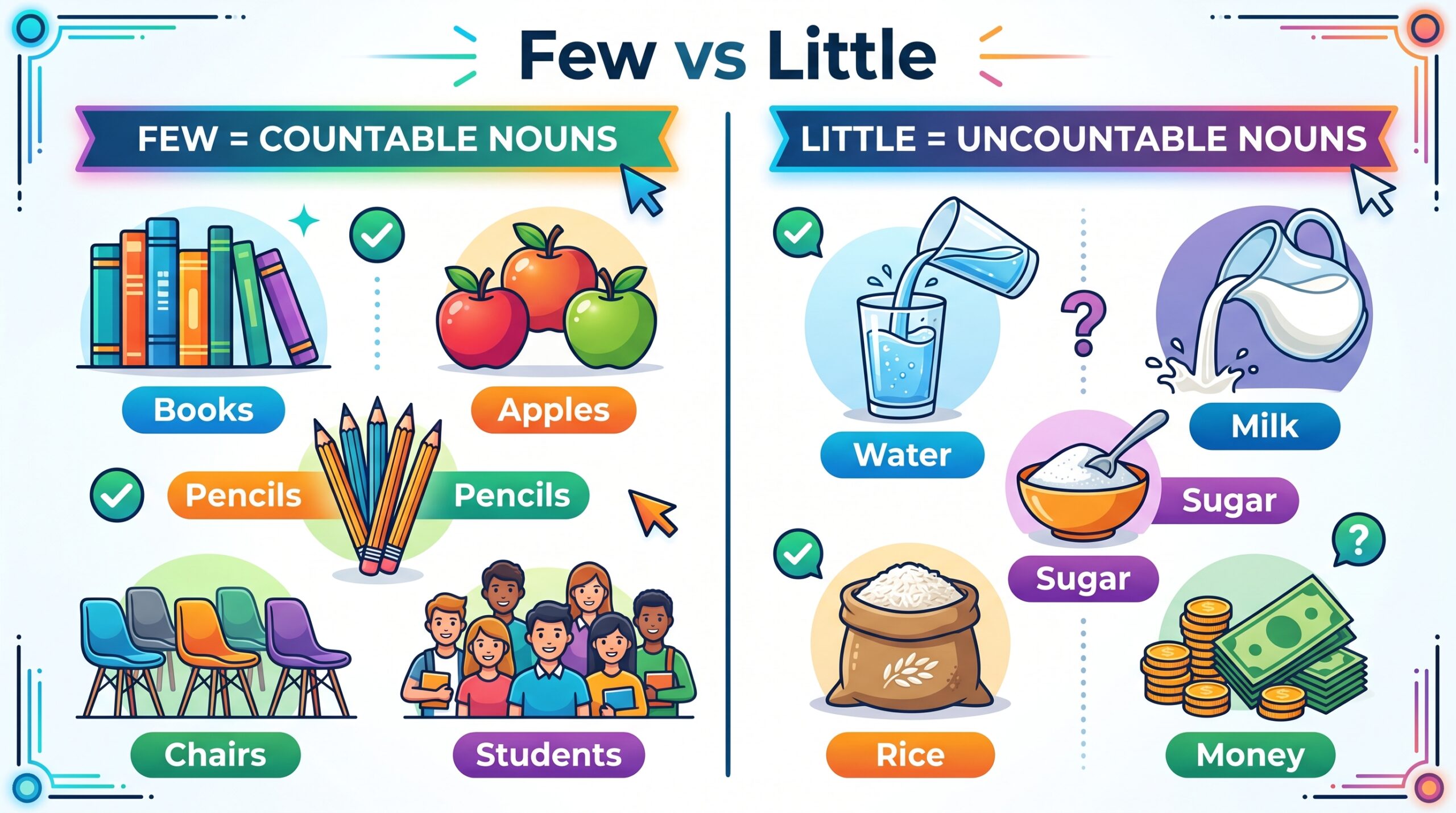
Learning the difference between few vs little is important for improving your English grammar skills. These words may seem similar because both describe small quantities, but they are used differently. Using the wrong one can change the meaning of your sentence and create confusion.
In this guide, you will learn the meanings of few and little, their rules, examples, common mistakes, and practice exercises.
What Are “Few” and “Little”?
Both few and little describe a small quantity of something.
The main difference is:
- Few → used with countable nouns
- Little → used with uncountable nouns
Understanding whether a noun is countable or uncountable helps you choose the correct word.
What Is “Few”?
Few is used with things that can be counted individually.
Examples of countable nouns:
- Books
- Pens
- Students
- Cars
- Apples
Examples:
- I have few friends in this city.
- There are few chairs in the room.
- She bought few books yesterday.
- Only few students attended the meeting.
The word few often suggests not many or almost none.
What Is “Little”?
Little is used with nouns that cannot be counted individually.
Examples of uncountable nouns:
- Water
- Sugar
- Money
- Information
- Time
Examples:
- We have little time left.
- There is little milk in the fridge.
- She has little money.
- I have little information about the project.
Little usually means not much.
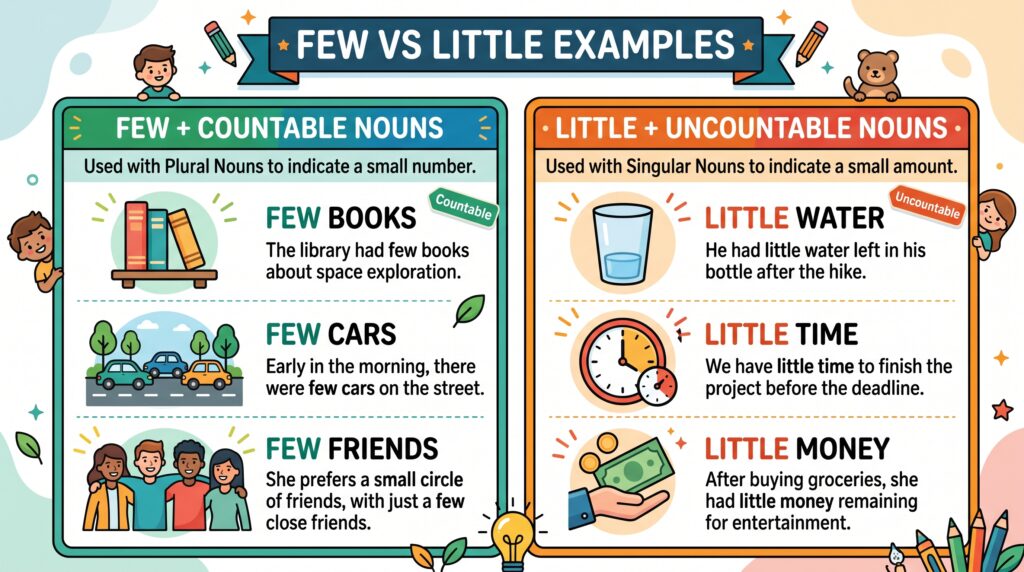
Few vs Little Difference Chart
| Feature | Few | Little |
|---|---|---|
| Used with | Countable nouns | Uncountable nouns |
| Meaning | Small number | Small amount |
| Examples | Few books | Little water |
| Indicates | Not many | Not much |
Difference Between Few and A Few
Many learners confuse few and a few.
Few
Means almost none or not enough.
Examples:
- Few people came to the event.
- Few students passed the test.
A Few
Means some or a small number.
Examples:
- I have a few friends in school.
- She bought a few apples.
Difference Between Little and A Little
Little
Means almost no amount.
Examples:
- We have little hope.
- There is little water left.
A Little
Means some amount.
Examples:
- I need a little sugar.
- She has a little experience.
Examples of Few in Sentences
- I have few relatives nearby.
- Few children were playing outside.
- There are few buses after midnight.
- He has few opportunities to travel.
- Few people understand the problem.
Examples of Little in Sentences
- We have little patience today.
- There is little coffee remaining.
- She has little interest in sports.
- I know little about computers.
- They showed little concern about the issue.
Rules for Using Few vs Little
Rule 1: Use Few with Countable Nouns
Correct:
Few students attended class.
Incorrect:
Few water remained.
Rule 2: Use Little with Uncountable Nouns
Correct:
Little information is available.
Incorrect:
Little books are on the shelf.
Rule 3: Use “A Few” and “A Little” for Positive Meaning
Correct:
I have a few ideas.
We still have a little time.
Rule 4: Use Few and Little for Negative Meaning
Correct:
Few people arrived.
Little progress was made.
Common Mistakes with Few and Little
Mistake 1: Using Few with Uncountable Nouns
Few milk is left.
Little milk is left.
Mistake 2: Using Little with Countable Nouns
Little students attended class.
Few students attended class.
Mistake 3: Confusing Few with A Few
Few books means some books.
Few books means almost none.
A few books means some books.
Quick Summary of Few vs Little
| Word | Noun Type | Meaning |
|---|---|---|
| Few | Countable | Not many |
| A Few | Countable | Some |
| Little | Uncountable | Not much |
| A Little | Uncountable | Some amount |
Practice Exercise
Choose few, a few, little, or a little.
- I have _____ money in my wallet.
- She bought _____ books from the store.
- There is _____ water left in the bottle.
- _____ students understood the lesson.
- We still have _____ time before class starts.
Answers
- little
- a few
- little
- few
- a little
Conclusion
Understanding few vs little helps you speak and write more accurately in English. Remember the simple rule: few goes with countable nouns and little goes with uncountable nouns. Practice using them in daily conversations and writing, and soon choosing the correct word will become natural.
FAQs About Few vs Little
What is the difference between few and little?
Few is used with countable nouns, while little is used with uncountable nouns.
Can few and little be used interchangeably?
No. Their usage depends on the noun type.
What is the difference between few and a few?
Few means almost none, while a few means some.
What is the difference between little and a little?
Little means almost no amount, while a little means some amount.
How can I learn few vs little easily?
Remember: Few counts things; little measures things.