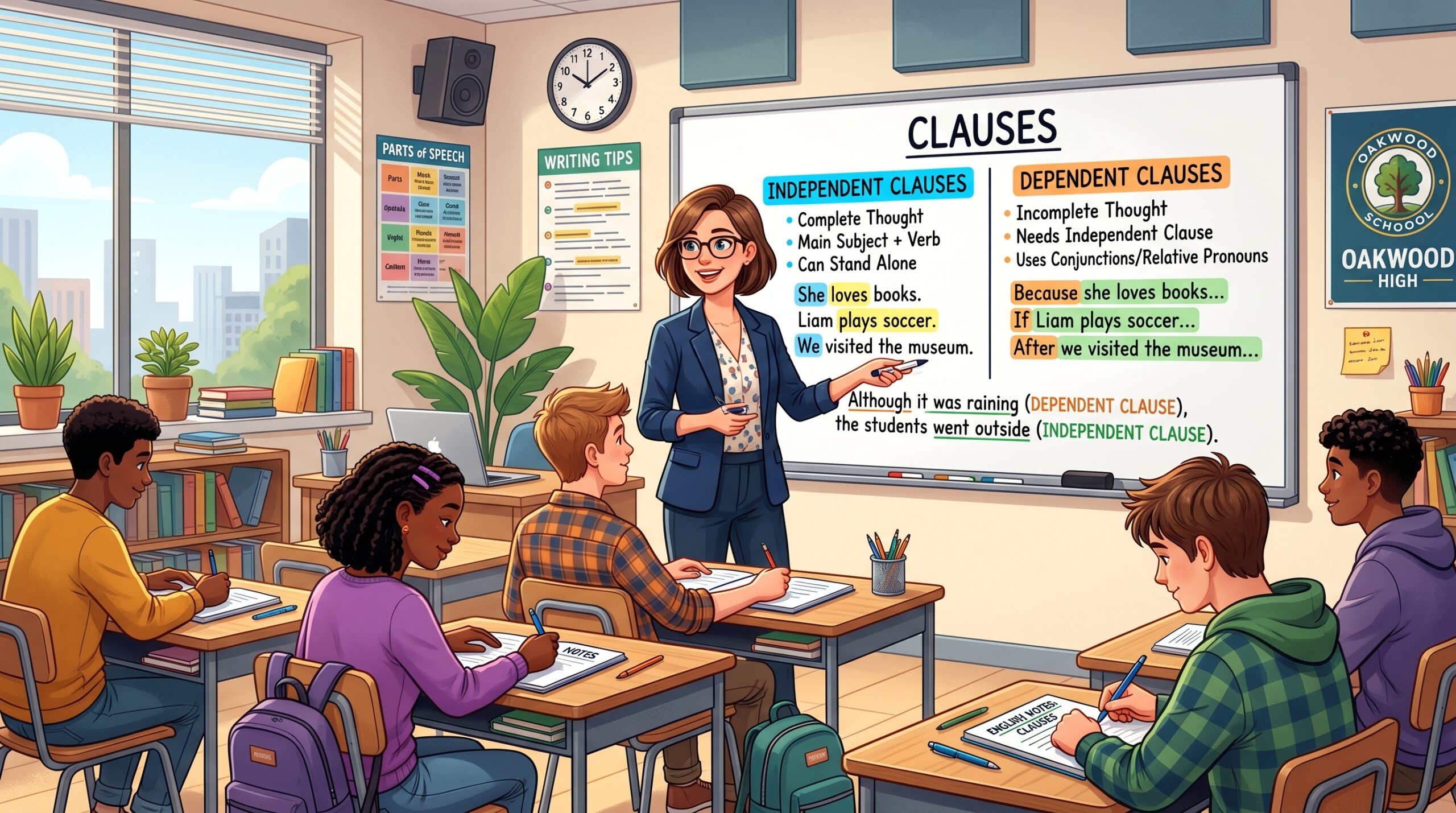
Have you ever wondered why some groups of words feel complete while others seem unfinished? The answer lies in understanding clauses. Clauses are one of the most important parts of English grammar because they form the foundation of every sentence.
Learning how clauses work will improve your writing, speaking, and overall grammar skills. In this simple guide, you will learn what a clause is, the types of clauses, grammar rules, examples, common mistakes, and practice exercises.
What Is a Clause?
A clause is a group of words that contains:
- A subject
- A verb
The subject tells us who or what performs the action, and the verb describes the action or state.
Example:
- She runs
- Subject = She
- Verb = runs
Without both a subject and a verb, a group of words is not a clause.
Example:
- “under the table” → not a clause
- “the dog barked” → clause
There are two main types of clauses in English grammar:
- Independent Clauses
- Dependent Clauses
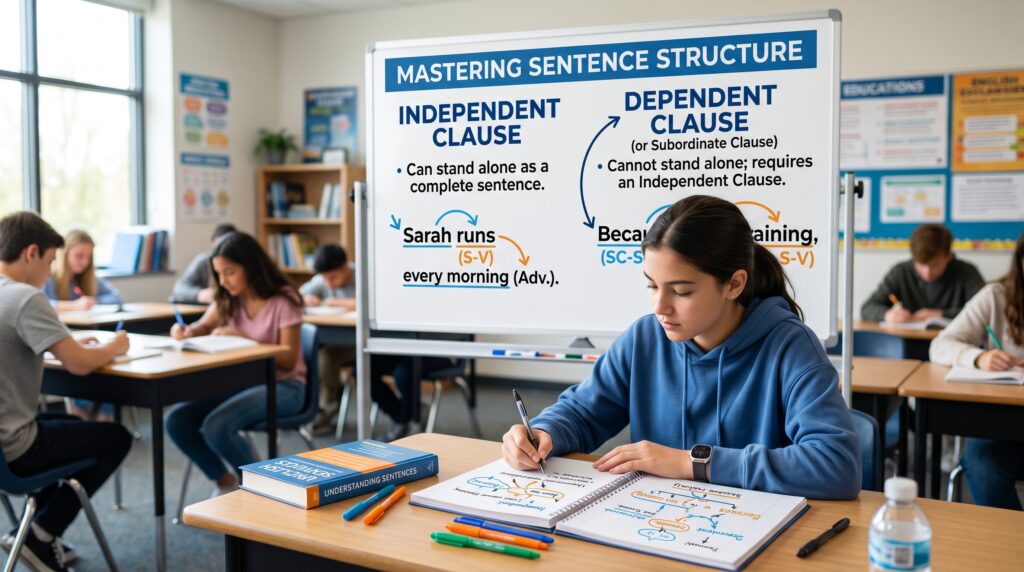
Types of Clauses
1. Independent Clause
An independent clause expresses a complete thought and can stand alone as a sentence.
Examples:
- I love coffee.
- She studies every night.
- The baby is sleeping.
These clauses make complete sense on their own.
2. Dependent Clause
A dependent clause does not express a complete thought. It must be connected to an independent clause.
Dependent clauses usually begin with subordinating conjunctions such as:
- because
- although
- when
- if
- while
- since
- after
Examples:
- because I was tired
- when the rain stopped
- although she was busy
These examples are incomplete by themselves.
Rules for Clauses
Rule 1: Every Clause Needs a Subject and Verb
Correct:
- The cat sleeps.
Incorrect:
- Sleeping quietly.
Rule 2: Independent Clauses Express Complete Thoughts
Example:
- We watched a movie.
This sentence is complete and understandable.
Rule 3: Dependent Clauses Need More Information
Example:
- Because we watched a movie…
This sentence leaves the reader waiting for more information.
Rule 4: Dependent Clauses Often Start with Subordinating Conjunctions
Examples:
- because
- although
- while
- after
- before
- unless
Rule 5: Sentences Can Have Multiple Clauses
Example:
- I stayed home because I was sick.
Independent clause:
- I stayed home
Dependent clause:
- because I was sick
How to Use Clauses Correctly
Step 1: Find the Subject and Verb
Ask:
- Who is doing the action?
- What is happening?
Example:
- The children played outside.
- Subject = children
- Verb = played
Step 2: Decide if the Clause Is Complete
Complete Thought:
- She likes pizza.
Incomplete Thought:
- because she likes pizza
Step 3: Join Dependent Clauses Properly
Correct:
- We stayed home because it was raining.
Incorrect:
- Because it was raining.
Step 4: Use Commas Correctly
Use a comma after a dependent clause when it comes first.
Example:
- Because it was cold, we stayed inside.
No comma is needed if the independent clause comes first.
Example:
- We stayed inside because it was cold.
Examples of Clauses in Sentences
- She sings beautifully. (Independent clause)
- Because I was tired, I went to bed early. (Dependent + independent clause)
- I will call you when I arrive. (Independent + dependent clause)
- Although he studied hard, he failed the test.
- The boy who won the race is my cousin.
- If you practice daily, you will improve quickly.
- After the movie ended, we went home.
- She smiled because she was happy.
- While I was cooking, the phone rang.
- I know that you are telling the truth.
Common Mistakes with Clauses
Mistake 1: Writing a Dependent Clause Alone
Because I was hungry.
I ate dinner because I was hungry.
Mistake 2: Missing the Subject
Is raining outside.
It is raining outside.
Mistake 3: Wrong Comma Usage
I stayed home, because I was sick.
I stayed home because I was sick.
Mistake 4: Confusing Clauses and Phrases
Running in the park. (phrase)
She is running in the park. (clause)
Mistake 5: Joining Independent Clauses Incorrectly
I love English I study every day.
I love English, and I study every day.
Quick Summary
- A clause contains a subject and a verb.
- Independent clauses can stand alone.
- Dependent clauses need an independent clause.
- Dependent clauses often begin with subordinating conjunctions.
- Use commas after introductory dependent clauses.
- Clauses help create clearer and more natural sentences.
Practice Exercises
Fill in the blanks with the correct word.
- ________ you finish your homework, you can play games.
- She stayed home ________ she was feeling sick.
- ________ the rain stopped, we went outside.
- I will help you ________ you ask politely.
- He was tired, ________ he continued working.
Answers
- After / When
- because
- After / When
- if
- but / yet
Conclusion
Now you understand what a clause is in English grammar and how to use clauses correctly in sentences. Remember that every clause must contain a subject and a verb. Independent clauses can stand alone, while dependent clauses need extra support.
The more you practice identifying and combining clauses, the more natural your English writing and speaking will become.
FAQs
1. What is the difference between a clause and a phrase?
A clause has both a subject and a verb, while a phrase does not.
Example:
- Phrase: “under the chair”
- Clause: “The cat slept under the chair.”
2. Can a sentence have more than one clause?
Yes. Many sentences contain multiple clauses.
Example:
- I stayed home because I was sick.
3. What is an independent clause?
An independent clause is a complete sentence that can stand alone.
Example:
- She likes music.
4. What is a dependent clause?
A dependent clause cannot stand alone and needs an independent clause.
Example:
- because she likes music
5. Do dependent clauses always need commas?
Only when the dependent clause comes before the independent clause.
Example:
- Because it was raining, we stayed home.
- We stayed home because it was raining.