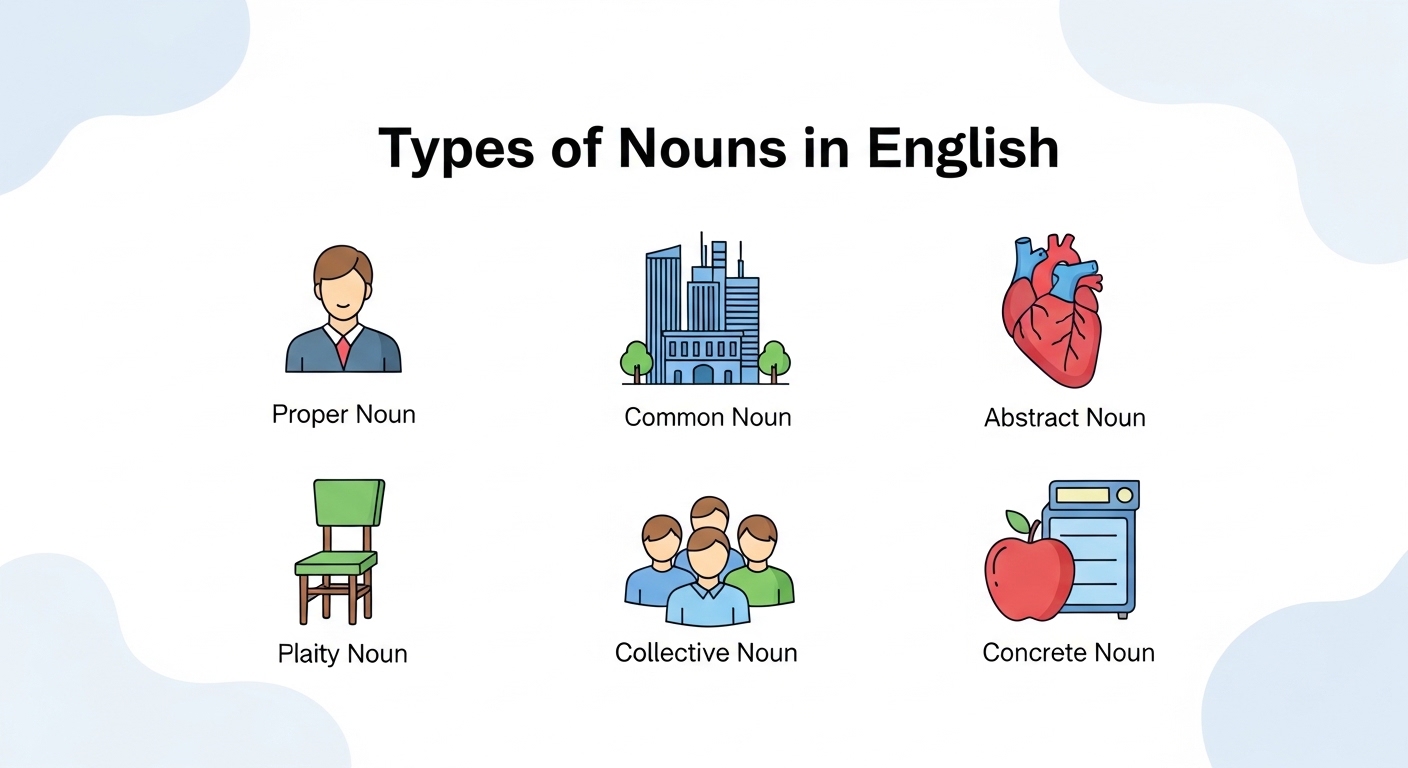
Nouns are one of the most important parts of English grammar. They help us name people, places, things, and ideas, making our sentences clear and meaningful.
In this guide, you’ll learn all types of nouns in English with simple definitions, examples, and easy explanations to improve your grammar skills.
What is a Noun?
A noun is a word used to name a person, place, animal, thing, or idea.
Examples:
- Person: teacher, Ali
- Place: school, Pakistan
- Thing: book, phone
- Idea: happiness, freedom

Main Types of Nouns in English
Let’s explore the most important types of nouns step by step:
1. Common Nouns
Common nouns refer to general names of people, places, or things. They are not capitalized unless they begin a sentence.
Examples:
- boy, city, car, teacher
These nouns are general and do not name anything specific.
2. Proper Nouns
Proper nouns are specific names of people, places, or organizations. They always begin with a capital letter.
Examples:
- Ali, London, Toyota, Pakistan
These nouns give exact identity.
3. Abstract Nouns
Abstract nouns represent ideas, emotions, or qualities that cannot be seen or touched.
Examples:
- love, honesty, happiness, freedom
You can feel them, but not see them.
4. Collective Nouns
Collective nouns refer to a group of people, animals, or things.
Examples:
- team, family, herd, class
These nouns represent many members as one group.
5. Concrete Nouns
Concrete nouns are things you can see, touch, hear, smell, or taste.
Examples:
- apple, chair, dog, house
These nouns are physical and real.
6. Countable Nouns
Countable nouns are things that can be counted.
Examples:
- book, pen, apple, student
You can say: one book, two books, three books.
7. Uncountable Nouns
Uncountable nouns cannot be counted individually.
Examples:
- water, milk, sugar, information
You cannot say “two waters” (instead: two bottles of water).
Why Are Nouns Important?
Understanding nouns helps you:
- Write clear and correct sentences
- Improve communication skills
- Avoid grammar mistakes
- Build strong vocabulary
Without nouns, sentences would have no meaning.
Common Mistakes to Avoid
- ❌ Not capitalizing proper nouns
- ❌ Confusing abstract and concrete nouns
- ❌ Using countable nouns as uncountable
- ❌ Incorrect subject-verb agreement with collective nouns
Quick Tips to Learn Nouns Easily
- Practice with daily examples
- Read simple sentences and identify nouns
- Group nouns by type
- Use flashcards for better memory
Conclusion
Learning the types of nouns in English is essential for mastering grammar. Once you understand how each type works, you can write more clearly and confidently.
Start practicing today, and you’ll quickly improve your English skills!
FAQs About Types of Nouns
1. How many types of nouns are there?
There are mainly 7 types: common, proper, abstract, collective, concrete, countable, and uncountable nouns.
2. What is the difference between common and proper nouns?
Common nouns are general names, while proper nouns are specific names and always capitalized.
3. What are abstract nouns?
They are ideas or feelings that cannot be seen or touched.
4. Why are nouns important in English?
Nouns help form meaningful sentences and improve communication.