Pronouns are one of the most important parts of English grammar. They help replace nouns in sentences, making communication smoother and less repetitive. Without pronouns, our sentences would sound awkward and repetitive.
In this guide, you will learn the different types of pronouns, their definitions, examples, rules, and common mistakes. By the end of this article, you will understand how to use pronouns correctly in speaking and writing.
What Are Pronouns?
A pronoun is a word used in place of a noun. Pronouns make sentences shorter, clearer, and easier to understand.
Example:
- Ali is my friend. He is very kind.
In this sentence, he replaces the noun Ali.
Why Are Pronouns Important?
Pronouns help:
- Avoid repetition
- Improve sentence flow
- Make communication clearer
- Create natural conversations
Without Pronouns:
- Maria said Maria would bring Maria’s bag.
With Pronouns:
- Maria said she would bring her bag.
Main Types of Pronouns
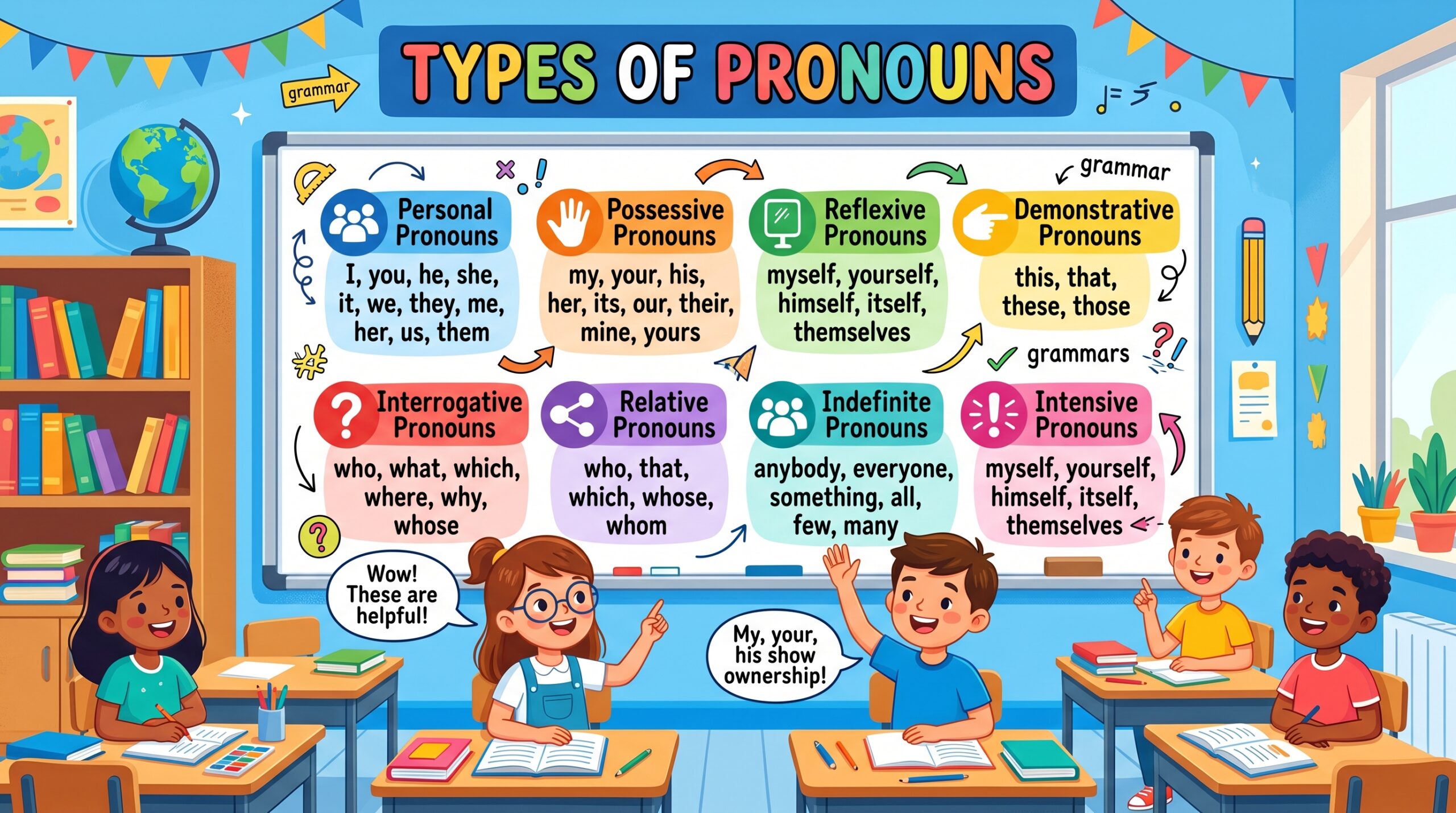
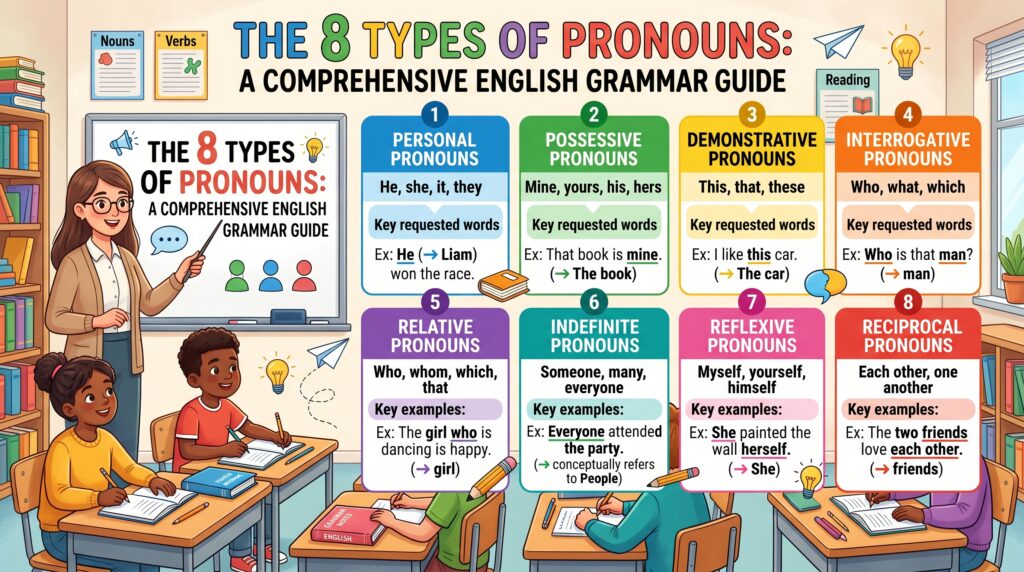
There are eight major types of pronouns in English grammar.
- Personal Pronouns
- Possessive Pronouns
- Demonstrative Pronouns
- Relative Pronouns
- Interrogative Pronouns
- Indefinite Pronouns
- Reflexive Pronouns
- Intensive Pronouns
1. Personal Pronouns
Personal pronouns refer to specific people, animals, places, or things.
Examples:
- I
- You
- He
- She
- It
- We
- They
Example Sentences:
- She is my best friend.
- They are playing football.
- We are going to school.
2. Possessive Pronouns
Possessive pronouns show ownership or possession.
Examples:
- Mine
- Yours
- His
- Hers
- Ours
- Theirs
Example Sentences:
- This book is mine.
- The red car is theirs.
- That bag is hers.
3. Demonstrative Pronouns
Demonstrative pronouns point to specific people or things.
Examples:
- This
- That
- These
- Those
Example Sentences:
- This is my notebook.
- Those are beautiful flowers.
- These belong to me.
4. Relative Pronouns
Relative pronouns connect one clause to another.
Examples:
- Who
- Whom
- Whose
- Which
- That
Example Sentences:
- The boy who won the race is my cousin.
- This is the book that I bought yesterday.
- The girl whose phone rang left early.
5. Interrogative Pronouns
Interrogative pronouns are used to ask questions.
Examples:
- Who
- Whom
- Which
- What
- Whose
Example Sentences:
- Who is calling you?
- Which is your favorite color?
- What do you want to eat?
6. Indefinite Pronouns
Indefinite pronouns refer to non-specific people or things.
Examples:
- Someone
- Anyone
- Everyone
- Nobody
- None
Example Sentences:
- Everyone enjoyed the party.
- Someone is knocking at the door.
- Nobody answered the question.
7. Reflexive Pronouns
Reflexive pronouns are used when the subject and object are the same person or thing.
Examples:
- Myself
- Yourself
- Himself
- Herself
- Ourselves
- Themselves
Example Sentences:
- I taught myself English.
- She hurt herself while cooking.
- They prepared themselves for the test.
8. Intensive Pronouns
Intensive pronouns emphasize another noun or pronoun.
Examples:
- Myself
- Yourself
- Himself
- Herself
- Themselves
Example Sentences:
- I completed the project myself.
- The principal herself announced the result.
- They themselves admitted the mistake.
Difference Between Reflexive and Intensive Pronouns
Although both use the same words, their purposes are different.
| Reflexive Pronoun | Intensive Pronoun |
|---|---|
| Shows action returns to subject | Adds emphasis |
| Necessary for sentence meaning | Can be removed without changing meaning |
Examples:
- She blamed herself. (Reflexive)
- She herself cooked dinner. (Intensive)
Pronoun-Antecedent Agreement
A pronoun must agree with the noun it replaces in:
- Number
- Gender
- Person
Correct Examples:
- Ali lost his keys.
- The girls completed their homework.
Incorrect Example:
- The boys forgot his bags.
Corrected:
- The boys forgot their bags.
Common Pronoun Mistakes
1. Using Vague Pronouns
They said it was broken.
(What is “it”?)
The phone was broken.
2. Wrong Pronoun Agreement
Every student must bring their book.
Every student must bring his or her book.
3. Confusing “Who” and “Whom”
- Use who as the subject.
- Use whom as the object.
Examples:
- Who called you?
- Whom did you invite?
20 Examples of Pronouns in Sentences
- She loves music.
- We are ready for the trip.
- This is my favorite movie.
- They cleaned the room themselves.
- Someone left a message for you.
- Which do you prefer?
- The book is mine.
- He completed the task himself.
- Those are my shoes.
- I can help you.
- Everybody enjoyed the game.
- The teacher who helped me is kind.
- Hers is the blue bicycle.
- Nobody knew the answer.
- That belongs to us.
- She introduced herself.
- Whose jacket is this?
- We prepared ourselves for the competition.
- These are delicious cookies.
- He himself fixed the computer.
Easy Exercise on Pronouns
Choose the correct pronoun.
- This pen belongs to ___ .
(a) mine
(b) me
(c) my - ___ is your English teacher?
(a) Who
(b) Which
(c) What - They enjoyed ___ at the picnic.
(a) themselves
(b) them
(c) their
Answers:
- mine
- Who
- themselves
Tips to Learn Pronouns Easily
- Practice replacing nouns with pronouns.
- Read simple English stories.
- Learn one pronoun type at a time.
- Write your own example sentences daily.
- Listen to English conversations carefully.
Conclusion
Understanding the Types of Pronouns is essential for improving English grammar and communication skills. Pronouns help make sentences more natural, clear, and engaging. By learning each type with examples and practicing regularly, beginners can develop stronger speaking and writing abilities.
Keep practicing daily, and soon using pronouns correctly will become easy and natural.
FAQs About Types of Pronouns
What are the 8 types of pronouns?
The 8 main types are:
- Personal
- Possessive
- Demonstrative
- Relative
- Interrogative
- Indefinite
- Reflexive
- Intensive
Why are pronouns important?
Pronouns make sentences shorter, clearer, and less repetitive.
What is a personal pronoun?
A personal pronoun refers to a specific person or thing, such as he, she, or they.
What is the difference between reflexive and intensive pronouns?
Reflexive pronouns reflect action back to the subject, while intensive pronouns only add emphasis.
How can I improve my use of pronouns?
Practice writing sentences, read English books, and pay attention to pronoun usage in conversations.