
Understanding the difference between “each” and “every” is important for clear and correct English. These two words may look similar, but they are used in different situations.
In this guide, you’ll learn simple rules, clear differences, and easy examples to use each and every correctly in daily English.
What Do “Each” and “Every” Mean?
Both each and every are used to talk about a group, but the way they focus on that group is different.
- Each → focuses on individuals one by one
- Every → focuses on the whole group together
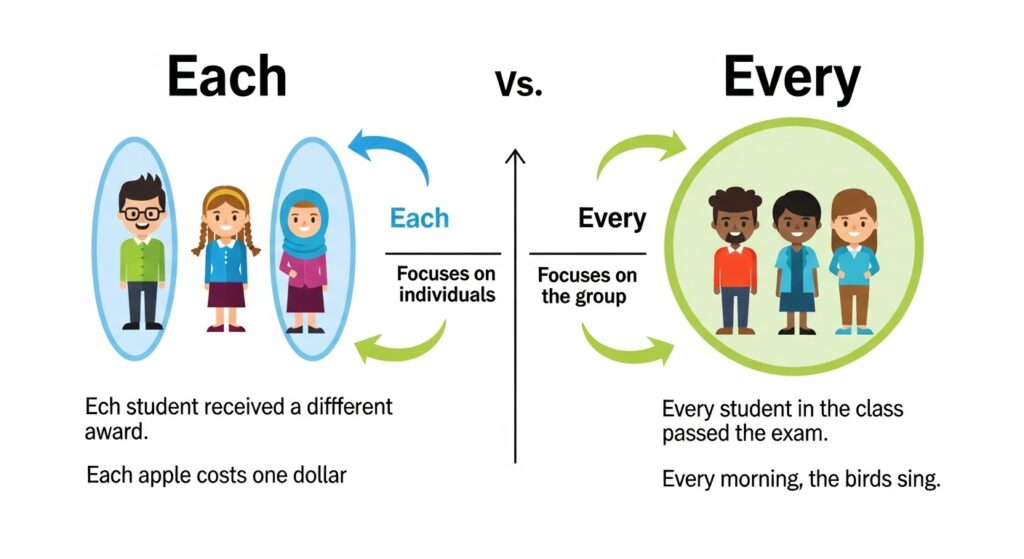
Main Difference Between Each and Every
| Each | Every |
|---|---|
| Focuses on individual members | Focuses on the whole group |
| Used for small or specific groups | Used for general or large groups |
| Emphasizes differences | Emphasizes completeness |
Examples:
- Each student has a book. (one by one)
- Every student must complete the task. (all together)
When to Use “Each”
Use “each” when you want to talk about individual items separately.
Examples:
- Each child received a gift.
- Each of the players is ready.
- Each book is different.
👉 Use “each” when individual attention is important.
When to Use “Every”
Use “every” when you talk about all members as a group.
Examples:
- Every student must wear a uniform.
- Every house on this street is new.
- Every day is a new opportunity.
👉 Use “every” for general statements.
Important Grammar Rule
Both each and every are followed by singular nouns and verbs.
Examples:
- Each student is حاضر
- Every car is expensive
❌ Incorrect:
- Each students are…
- Every cars are…
Each vs Every (Quick Comparison)
- Use each → when thinking about people/things individually
- Use every → when thinking about all together
Common Mistakes to Avoid
- ❌ Using plural nouns after each/every
- ❌ Mixing both in the same sentence incorrectly
- ❌ Ignoring the difference in meaning
Easy Tips to Remember
- Think: Each = One by one
- Think: Every = All together
- Use “each” for small groups
- Use “every” for general ideas
Conclusion
Learning the difference between each vs every helps you write and speak more clearly. By understanding when to focus on individuals or the whole group, you can avoid common grammar mistakes and improve your English skills.
Practice regularly, and soon you’ll use both words confidently!
FAQs About Each vs Every
1. What is the difference between each and every?
“Each” focuses on individuals, while “every” focuses on the whole group.
2. Can we use each and every together?
Sometimes, but only in special cases. Usually, they are used separately.
3. Are each and every singular?
Yes, both are always followed by singular nouns and verbs.
4. Which is more common in daily use?
“Every” is more common for general statements.