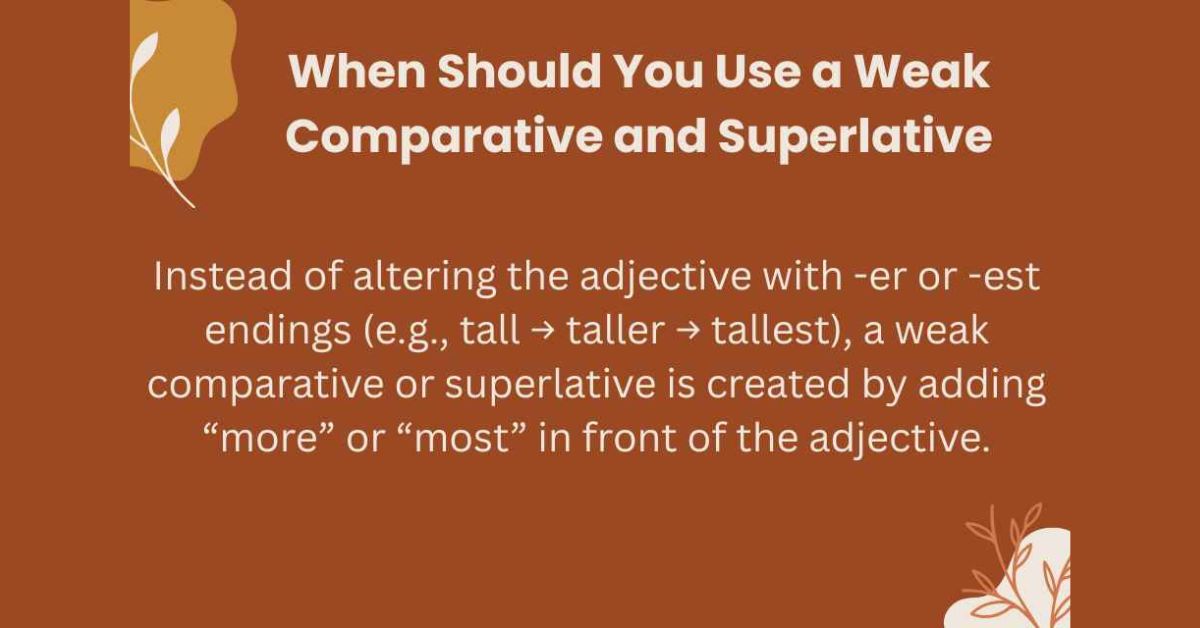
Weak comparative and superlative forms are used when comparing adjectives that do not follow the typical -er and -est pattern. These forms often rely on more and most to make comparisons clear and grammatically correct.
You should use weak comparatives and superlatives when an adjective sounds awkward or unclear with endings, especially longer or descriptive words. This helps your sentences sound natural and easy to understand.
What is a Weak Comparative?
A weak comparative refers to the comparative form of adjectives that do not express extreme differences but instead show a slight or moderate comparison. Unlike strong comparatives such as better, stronger, faster, weak comparatives often sound softer and less forceful.
Examples of weak comparatives:
- weak → weaker
- simple → simpler
- gentle → gentler
- narrow → narrower
What is a Weak Superlative?
A weak superlative is the highest form of an adjective, but it still does not express an extreme quality. It indicates the mildest form of superiority among a group.
Examples of weak superlatives:
- weak → weakest
- simple → simplest
- gentle → gentlest
- narrow → narrowest
The Degrees of Comparison in Grammar
English adjectives typically have three degrees of comparison:
- Positive Degree → The base form of the adjective (weak, simple, narrow).
- Comparative Degree → Used to compare two things (weaker, simpler, narrower).
- Superlative Degree → Used to compare more than two things (weakest, simplest, narrowest).
Rules for Forming Weak Comparatives and Superlatives
Short Adjectives (one syllable)
- Add –er for comparative and –est for superlative.
- Examples: weak → weaker → weakest, small → smaller → smallest.
Adjectives ending in –e
- Add –r for comparative and –st for superlative.
- Examples: simple → simpler → simplest, gentle → gentler → gentlest.
Adjectives ending in consonant + y
- Change y to i and add -er or -est.
- Example: easy → easier → easiest.
Adjectives with two or more syllables (not ending in –y)
- Use more for comparative and most for superlative.
- Example: careful → more careful → most careful.
Examples in Sentences
To make weak comparative and superlative forms clear, let’s use them in real contexts:
Comparative:
- This rope is weaker than that one.
- She is simpler in style than her sister.
- The road is narrower than the highway.
Superlative:
- He is the weakest player on the team.
- This method is the simplest way to solve the problem.
- That is the gentlest approach we can take.
Difference Between Weak and Strong Comparatives
| Aspect | Weak Comparative & Superlative | Every day, softer comparisons |
|---|---|---|
| Expression | Mild, less forceful | Intense, powerful |
| Example | weak → weaker → weakest | strong → stronger → strongest |
| Usage | Everyday, softer comparisons | Formal, persuasive, exaggerated tone |
Weak vs. Irregular Comparatives
Some adjectives don’t follow regular patterns at all. These are called irregular comparatives and superlatives. For example:
- good → better → best
- bad → worse → worst
These are not weak forms but rather irregular ones. Weak comparatives and superlatives still follow regular grammar rules but express milder comparisons.
Learn more: is am are worksheet
Common Mistakes with Weak Comparatives
Double Comparatives
- ❌ more weaker
✅ weaker
Wrong Suffix Use
- ❌ weakestest
✅ weakest
Using Comparative Instead of Superlative
- ❌ He is weaker of all players.
✅ He is the weakest of all players.
Weak Comparative and Superlative Word List
Here’s a quick reference table of common weak adjectives:
| Positive | Comparative | Superlative |
|---|---|---|
| weak | weaker | weakest |
| simple | simpler | simplest |
| gentle | gentler | gentlest |
| narrow | narrower | narrowest |
| humble | humbler | humblest |
| quiet | quieter | quietest |
Conclusion
Using weak comparative and superlative forms helps maintain clarity and natural flow in English sentences. They are especially useful with longer adjectives or words that do not sound right with -er or -est endings. By choosing more and most, you avoid awkward phrasing and improve readability. Understanding when to apply these forms makes your comparisons more accurate. This skill strengthens both spoken and written English.
Frequently Asked Questions
1. When should you use weak comparatives in English grammar?
You use weak comparatives when you want to show a slight or mild difference between two things. For example: This chair is weaker than that one.
2. What is the superlative form of weak adjectives?
The superlative form of weak adjectives is made by adding –est to the base adjective or using most before it. Example: weak → weakest, simple → simplest.
3. How are weak comparatives different from irregular comparatives?
Weak comparatives follow regular rules (weak → weaker → weakest), while irregular comparatives change completely (good → better → best, bad → worse → worst).